Blog

  • Jobs Switch Calculator: Step-by-Step Profit Guide

    Jobs Switch Calculator: Step-by-Step Profit Guide

    Your next jobs switch could forfeit $21,000 in unvested 401(k) matches—use this calculator to see if the raise is enough.

    You’re leaving $21,000 in unvested 401(k) matches behind with every job hop—here’s the exact formula to know if a raise actually covers that loss.

    💡

    By using the Gilinoh Raise & Job-Hop Velocity Calculator, mid-career professionals can quantitatively evaluate the financial trade-offs of a jobs switch, revealing that even a 12% raise may be insufficient to offset unvested employer match forfeiture—thus providing a data-driven framework for negotiating a signing bonus that neutralizes the golden handcuff dilemma.

    Short Answer

    In short: By using the Giniloh Raise & Job-Hop Velocity Calculator, mid-career professionals can quantitatively evaluate the financial trade-offs of a jobs switch, revealing that even a 12% raise may be insufficient to offset unvested employer match forfeiture—thus providing a data-driven

    Key Takeaways

    • Evaluate a new job offer by calculating the total ‘exit cost’ of unvested 401(k) matches and performance bonuses to ensure a salary increase results in a true net gain.
    • Account for the ‘Switching Deficit,’ a phenomenon where a higher starting salary can be offset within three years by lower annual raises and the loss of deferred compensation.
    • Use the specific dollar value of forfeited benefits as a professional negotiation tool to request a sign-on bonus that compensates for the financial loss of leaving a current role.
    • Prioritize long-term wealth velocity over immediate monthly cash flow by modeling your financial trajectory across several years for both ‘stay’ and ‘switch’ scenarios.

    Introduction: The True Cost of a Jobs Switch – Why You Need a Calculator

    Take the case of Sarah, a professional I recently consulted with. She received a job offer with a 12% salary increase and a senior title, which seemed like an easy win on the surface.

    The new company also promised a culture that prioritized the work-life balance she currently lacks. In my experience, these are the moments where emotions often override math. Sarah felt the new role fit her long-term goals and offered an immediate boost to her monthly take-home pay.

    However, I noticed a critical detail: Sarah was two years into a three-year “cliff” vesting schedule for her employer’s 401(k) contributions. If she resigned today, she would walk away from over $21,000 in unvested capital. This is a financial reality that many professionals overlook when they focus only on a higher base salary.

    In this case, the 12% raise might take nearly two years just to recover the lost retirement funds. This scenario is a classic example of what I call the “golden handcuffs” dilemma. It happens when the cost of leaving—due to lost benefits or deferred pay—is higher than the immediate gains of a new offer.

    The Necessity of Quantitative Analysis in Career Transitions

    Without a clear mathematical approach, a career move that looks like a step forward can actually be a lateral or even a backward financial shift. I believe a job switch should be evaluated with the same care as a major investment. A standard offer letter only tells part of the story.

    To understand the true value of a change, you must account for lost matches, pending bonuses, equity schedules, and the specific costs of moving. Professionals who skip this analysis risk slowing their wealth growth while thinking they are moving ahead. Data from the Atlanta Federal Reserve Bank shows that wage growth for job switchers has consistently outpaced stayers since 2011.

    However, national averages are broad and do not account for the details of high-level pay packages. A 12% raise is a common goal, but its value depends entirely on what you leave behind. If that raise is canceled out by the loss of a large unvested match, the benefit of switching disappears.

    Strategic Movement and Wealth Velocity

    Strategic movement is a powerful tool for building wealth, but its success depends on the timing and the specific terms of the move. To manage this complexity, the Gilinoh Raise & Job-Hop Velocity Calculator offers a structured way to look at these variables. The tool moves beyond simple feelings and applies financial modeling to the career transition process.

    It allows you to calculate the exact dollar impact of a move over several years. This ensures that quick gains are not lost to deferred costs. By using a data-driven approach, you can set aside the excitement of a new offer and focus on the math.

    The goal is to see if a new role increases your “wealth velocity” or if it just reshuffles your existing pay. In a competitive job market, precision is the difference between a smart move and a costly mistake. You must determine if the new role is worth the “buy-in” cost of leaving your current equity behind.
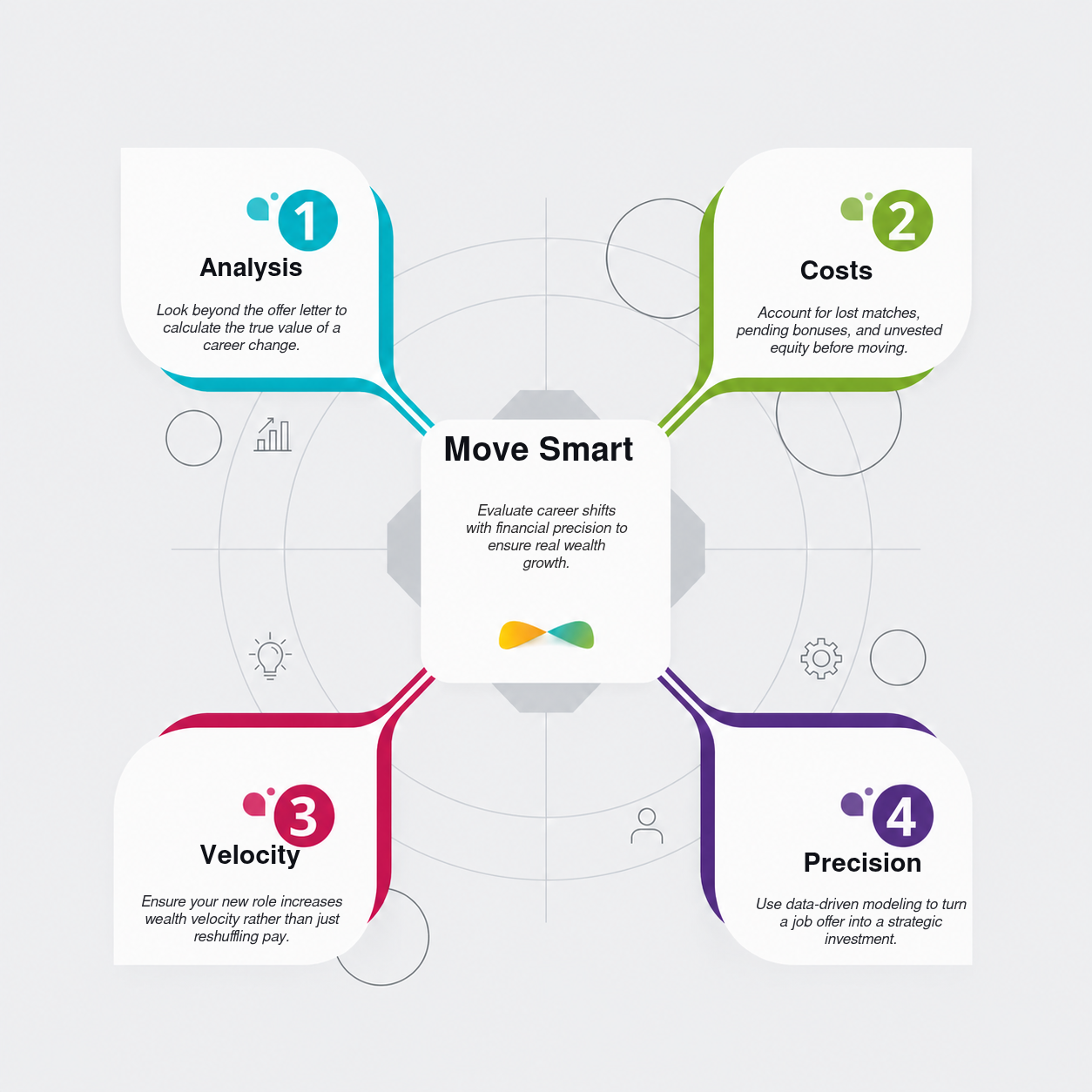
    Infographic: Without a clear mathematical approach, a career move that looks like a step forward can actually be

    The Financial Mechanics of the Vesting Cliff

    The 401(k) vesting schedule is a common tool used by employers to keep employees from leaving. These schedules usually follow a “cliff” or “graded” model. In a cliff scenario, you own none of the employer’s contributions until you reach a specific milestone—often three years.

    At that point, you suddenly own 100% of the funds. If a professional leaves at the 35-month mark in a three-year cliff, they lose every dollar the employer put into their retirement account. For someone earning $150,000 with a 6% match, that is $9,000 per year.

    Over nearly three years, the loss exceeds $26,000 when you include basic market growth. This is a significant “exit tax” that must be part of any new offer evaluation. Understanding the type of vesting you are under is the first step in calculating your exit cost.

    Table 1: Comparison of Common Vesting Structures

    Vesting Type

    Ownership Timeline

    Risk Factor for Job Switch

    Cliff Vesting

    0% until milestone (e.g., 3 years), then 100%

    High: Total loss if leaving early

    Graded Vesting

    Increments (e.g., 20% per year) over 5 years

    Moderate: Partial loss of future funds

    Immediate Vesting

    100% ownership from day one

    Low: No loss of employer contributions

    What Is the Job-Hop Velocity Calculator and Who Is It For?

    Standard career advice often claims that changing jobs is the most effective way to increase your salary. Data generally supports this idea. According to the Federal Reserve Bank of Atlanta’s Wage Growth Tracker, people who switch jobs have consistently seen higher yearly wage increases than those who stay with their current employers since 2011.

    This “loyalty penalty” often pushes professionals to look for new roles to maintain their market value. However, for mid-career professionals, deciding whether to move is rarely just about comparing base salaries. At this stage, compensation packages are more complex and include many different parts.

    Mid-career roles often feature complex structures like unvested 401(k) employer matches, performance bonuses, and long-term incentive plans. A simple salary comparison does not account for the “exit costs” of these assets. These costs represent the immediate financial loss an employee takes when walking away.

    Modeling Your Full Financial Path

    The Job-Hop Velocity Calculator helps address this specific complexity. It provides a clear framework to evaluate the true value of a career change over time. By looking beyond monthly cash flow, the tool shows the long-term impact on your total net worth.

    young Professional

    This financial tool is designed for one goal: helping you compare a “stay” scenario against a “switch” scenario with high precision. Unlike basic calculators that only look at hourly rates or taxes, this tool models your full financial path over several years. It includes hidden variables that can cancel out the benefits of a pay raise.

    By entering your current pay data and the terms of a new offer, you can project how your wealth will grow in both situations. This data-driven method removes the emotional bias that often comes with a new job title. The calculator answers an important question: is the immediate salary increase enough to cover the loss of deferred pay?

    A 15% raise can sometimes lead to a net loss in the first year when you include all costs. Knowing this “break-even” point is vital for any strategic career move. For those early in their careers, a 12% raise is usually a clear financial win, but mid-career professionals face higher stakes.

    Who Needs This Tool?

    The Job-Hop Velocity Calculator is for mid-career professionals whose total pay includes more than just a base paycheck. For a professional who is two years into a three-year vesting schedule, a 12% raise needs a closer look. Giving up thousands of dollars in unvested matching funds can lower the real value of the new offer.

    The calculator accounts for employer match limits, complex vesting schedules, and pro-rated bonus structures. It also factors in immediate transition costs, such as COBRA premiums or the temporary loss of insurance coverage. These “friction costs” often determine if a move is a success or just a lateral financial step.

    Data from the Bureau of Labor Statistics shows that employee tenure increases with age. Workers aged 55 to 64 have a median tenure more than three times longer than workers aged 25 to 34. As tenure increases, the financial “tether” to a current employer grows stronger.

    The Golden Handcuff Dilemma: A Real-World Scenario

    The Scenario That Keeps Mid-Career Engineers Up at Night

    Specialized engineering has changed over the last decade. The transition from early-career growth to mid-career stability now involves a major shift in how you receive your pay. It is no longer just about the number on your bi-weekly paycheck.

    For many, financial security is increasingly tied to deferred compensation. This is money you have earned on paper but cannot access yet. Consider a mid-career engineer earning a base salary of $120,000 per year who is navigating a “ticking clock” scenario involving retirement and bonus programs.

    This engineer is two years into a three-year 401(k) vesting cliff. The employer provides a dollar-for-dollar match on up to 6% of the base salary. Over two years, those contributions total $14,400. Because the engineer has not reached the three-year threshold, that money is effectively a loan from the company.

    If they leave today, they forfeit the entire sum immediately. The compensation package also includes an annual performance bonus of 10%. Due to the timing of the fiscal year, half of the current cycle’s bonus—roughly $6,000—is also unvested. Resigning now means leaving that money behind.

    Golden handcuffs

    The Hidden Cost of a Double-Digit Raise

    The situation gets complicated when an external opportunity appears. A recruiter offers a 12% increase in base salary, bringing the new pay to $134,400, plus a $5,000 signing bonus. For many, a double-digit raise is the ultimate benchmark for a career move.

    It feels like market validation and promises better monthly cash flow. But the hidden cost is the immediate loss of over $21,000 in unvested assets. When you account for the principal and the market growth of those retirement funds, the loss is substantial.

    Switching jobs is no longer a simple comparison of two salary figures. It is a complex calculation of total rewards and the timing of asset realization. Mid-career professionals must recognize that their market value is not just their base salary.

    The $4,000 Switching Deficit You Can’t Afford to Ignore

    To judge a career move accurately, you must look past the first year. You need to model the full trajectory of your earnings over several years. A simple comparison of Year 1 salaries misses the “transition friction” caused by lost benefits.

    When you use a comprehensive job switch model, a pattern of financial loss—the “Switching Deficit”—becomes visible. This model compares two paths: the “Stayer” and the “Switcher.” In this analysis, the Stayer receives a steady 4.1% annual merit increase.

    The Switcher gets that initial 12% jump but then sees more modest 3.0% annual raises. This reflects a common reality where companies give smaller raises to employees hired at the top of their salary band. The Switcher also faces immediate out-of-pocket costs like COBRA premiums.

    Table 2: Impact of Starting Salary on 30-Year Wealth Projection (Assumes 3% Annual Growth)

    Starting Salary

    Salary at Year 10

    Salary at Year 20

    Salary at Year 30

    $80,000

    $107,422

    $144,313

    $193,859

    $120,000

    $161,133

    $216,470

    $290,789

    $160,000

    $214,844

    $288,626

    $387,719

    The table above illustrates the compounding effect of salary growth over time. A $40,000 difference in starting pay results in a nearly $100,000 difference in annual income by year 30. This highlights why negotiating a higher starting salary is one of the most impactful financial moves you can make.

    Step-by-Step Configuration: Setting Up the Core Parameters

    The accuracy of any financial forecast depends on the quality of the data you provide. In long-term wealth modeling, “Core Parameters” serve as the fundamental assumptions that drive every calculation. These inputs form the architectural foundation of your entire financial plan.

    Inaccurate data leads to errors that compound over a multi-decade horizon. Professionals often refer to this as “Garbage In, Garbage Out.” To create a reliable roadmap, you must balance historical market data with conservative personal estimates.

    Approaching these variables with professional rigor ensures the final output is useful and actionable. A well-calibrated model identifies potential shortfalls before they become financial crises. It also highlights opportunities for strategic changes in tax planning or asset allocation.

    Starting Base Salary: Establishing the Baseline

    The calculator uses a default starting base salary of $120,000. This figure serves as a benchmark for mid-career professionals in sectors like technology, finance, or corporate management. It represents a typical earner in a major metropolitan market today.

    For the model to be effective, you must adjust this to your current “Total Cash Compensation.” Use the gross annual salary listed on your most recent employment contract or W-2. Accuracy here is vital because your salary is the primary engine of your savings rate.

    Distinguish clearly between cash salary and non-cash benefits. Health insurance premiums and employer-paid life insurance are valuable, but they do not belong in the “Base Salary” field. Only include income that appears on your payroll as regular cash earnings.

    If you are currently between roles, use a conservative estimate based on verified market data. Professional sites like Glassdoor or specialized industry salary surveys provide reliable ranges. Always lean toward the lower end of these ranges to maintain a margin of safety.

    Combined Tax Rate: Understanding Effective Liability

    The default combined tax rate is set at 32%. Many users confuse their “marginal tax bracket” with their “effective tax rate.” It is essential to use a realistic combined rate that includes federal, state, and local taxes to see your true take-home potential.

    Strategic career moves often result in salary increases that far exceed internal annual raises. While internal increases might hover between 3% and 5%, external moves can yield 10% to 20% gains . Because of these potential jumps, you should update your base salary in the calculator every year.

    Configuring the Stayer and Switcher Scenarios

    The Strategic Assessment: A Quantitative Approach

    A mid-career engineer currently earns a base salary of $120,000. They are two years into a three-year vesting cliff for their 401(k) employer contributions. A recruiter presents an opportunity featuring a 12% increase in base compensation and an elevated title.

    However, a professional transition requires more than a surface-level look at salary. A comprehensive financial analysis must determine the true economic impact of the move. This is where a jobs switch calculator becomes an essential tool for high-level decision-making.

    Sophisticated career moves look beyond nominal increases to evaluate the total rewards package. In many cases, the financial assets left behind at a current firm outweigh the immediate gains of a new role. You must determine if the projected increase remains positive after accounting for forfeited equity.

    The Comparative Framework: Stayer vs. Switcher Parameters

    To model long-term financial outcomes, we establish a baseline for two distinct career paths. The “Stayer” trajectory assumes consistent tenure with the current employer. This path benefits from a steady 4.1% annual merit increase, which aligns with current market standards .

    The Stayer path prioritizes the preservation of benefits and the realization of long-term incentive plans. It assumes the employee has already cleared the initial learning curve and is operating at peak efficiency. This stability often leads to more predictable bonus payouts.

    Conversely, the “Switcher” trajectory involves a strategic move every three years. This path assumes a 12% salary increase upon joining a new firm, supplemented by a $5,000 signing bonus . However, in the years between these transitions, the annual raise is modeled at a lower 3.0% rate.

    Table 3: Stayer vs. Switcher Financial Parameters

    Parameter

    Stayer Profile

    Switcher Profile

    Annual Merit Increase

    4.1% (Consistent)

    3.0% (Non-transition years)

    External Move Salary Increase

    N/A

    12.0% (Every 3 years)

    One-Time Signing Bonus

    $0

    $5,000

    Transition Costs (COBRA/Admin)

    $0

    $1,200

    Forfeiture of Unvested Match

    0%

    100% (Approx. $21,000)

    Forfeiture of Unvested Bonuses

    0%

    50%

    The “Switcher” profile includes significant financial friction. The immediate loss of 100% of unvested employer matches represents a substantial reduction in net worth. For our engineer, this loss is calculated at approximately $21,000, a figure that often shocks those who haven’t run the numbers.

    Step-by-Step Configuration:

    Open the Core Parameters tab and enter:

    • Starting Base Salary: $120,000

    • Combined Tax Rate: 32%

    • Portfolio Return Rate: 8%

    • Annual Bonus: 10%

    • Employer Match Limit: 6% (generous matching program)
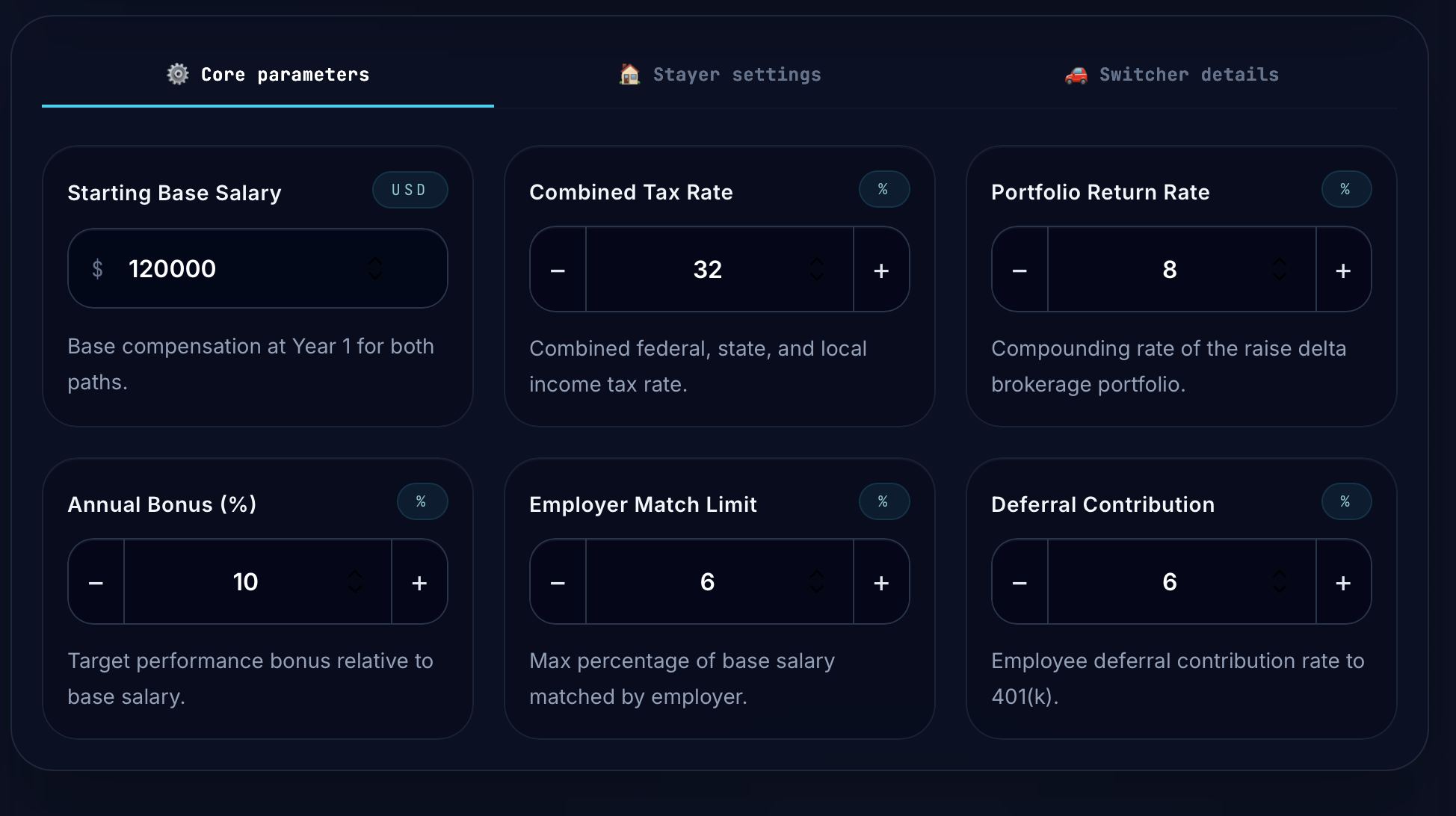
    Core Parameters

    Open the Stayer Settings tab:

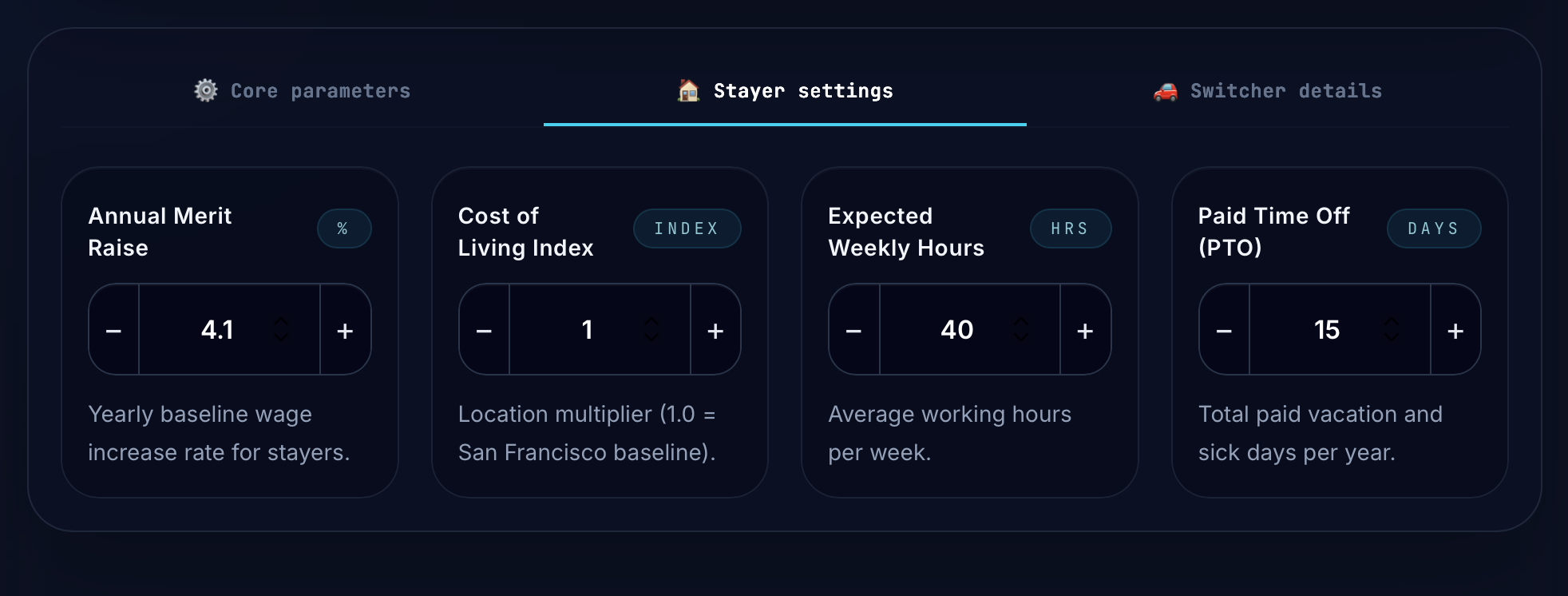
    • Annual Merit Raise: 4.1%

      Screenshot 2026-06-18 at 8.48.14 PM

    Open the Switcher Details tab:

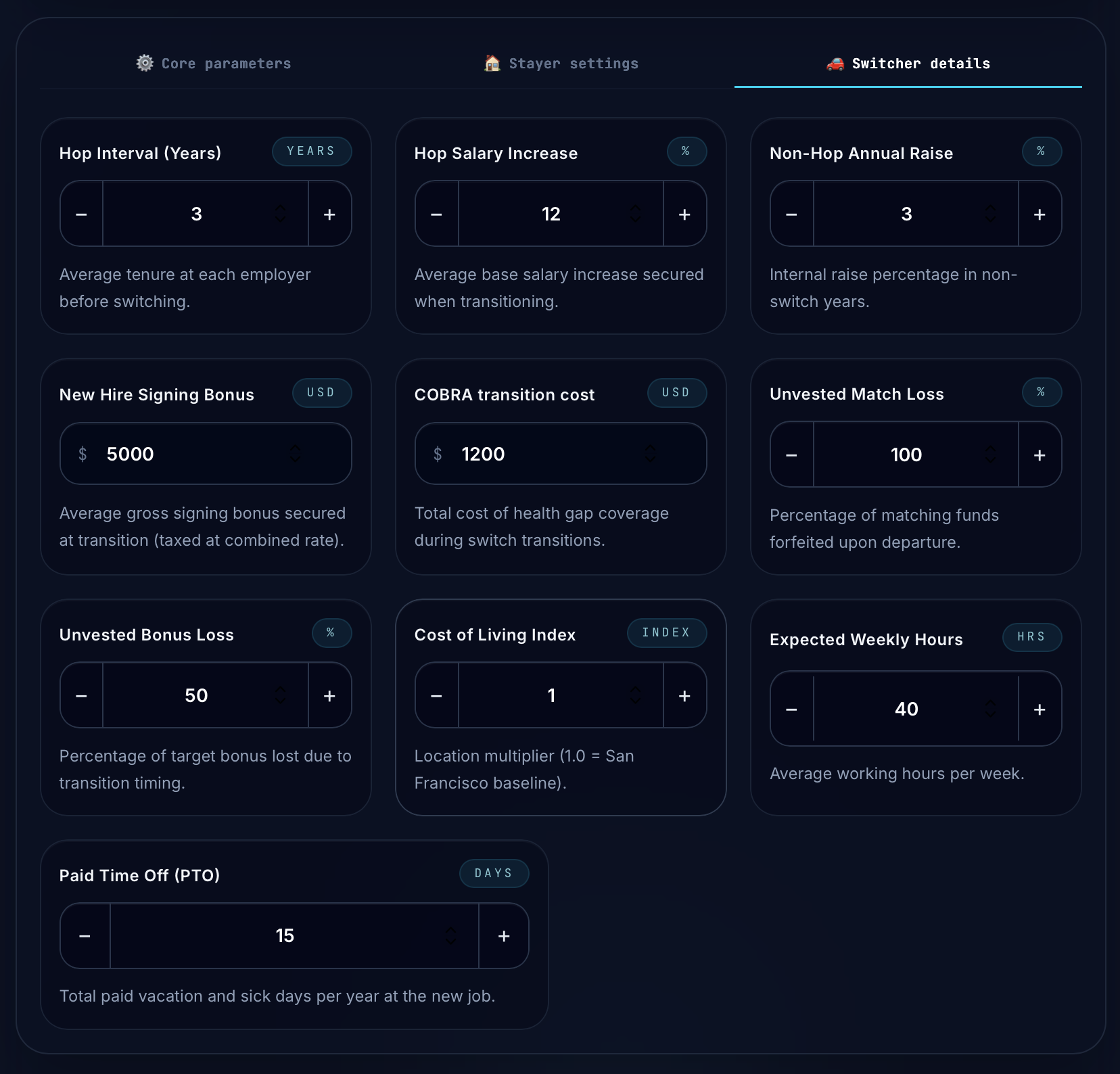
    • Hop Interval: 3 Years (timing the jump at the cliff end)

    • Hop Salary Increase: 12%

    • Non-Hop Annual Raise: 3.0%

    • New Hire Signing Bonus: $5,000 (used to offset matching losses)

    • COBRA Transition Cost: $1,200

    • Unvested Match Loss: 100% (forfeiting the matches accumulated during the 2 years before the transition)

    • Unvested Bonus Loss: 50%

    Switcher Details

    Interpreting the Output: The Switching Deficit

    The Year 3 Trap: When Switching Hurts More Than It Helps

    Here’s the thing nobody tells you about that shiny job offer: the numbers can look great on paper for about two years. Then reality hits. According to the calculator, the Switching Deficit becomes painfully visible in Year 3.

    That’s when the Switcher’s net income actually dips below the Stayer’s. We’re talking about a negative delta of roughly -$4,000. This happens because the initial salary bump and signing bonus were insufficient to cover the forfeited assets and the lower subsequent raises.

    Table 4: Summary of Hidden Transition Costs

    Cost Category

    Estimated Impact

    Description

    Unvested 401(k) Match

    $14,000 – $25,000

    Loss of employer contributions due to cliff vesting

    Prorated Bonus Loss

    $3,000 – $10,000

    Loss of earned but unpaid performance bonuses

    Benefit Gap (COBRA)

    $1,200 – $2,500

    Cost of maintaining insurance during the transition

    Opportunity Cost

    Variable

    Delayed promotion cycle at the new company

    Trajectory Insights

    The “Switching Deficit”: In Year 3, the switcher’s take-home pay dips below the stayer’s by -$26,955 (approx. -$27,000) due to forfeiting $22,900 in cumulative retirement matches, plus transition costs.
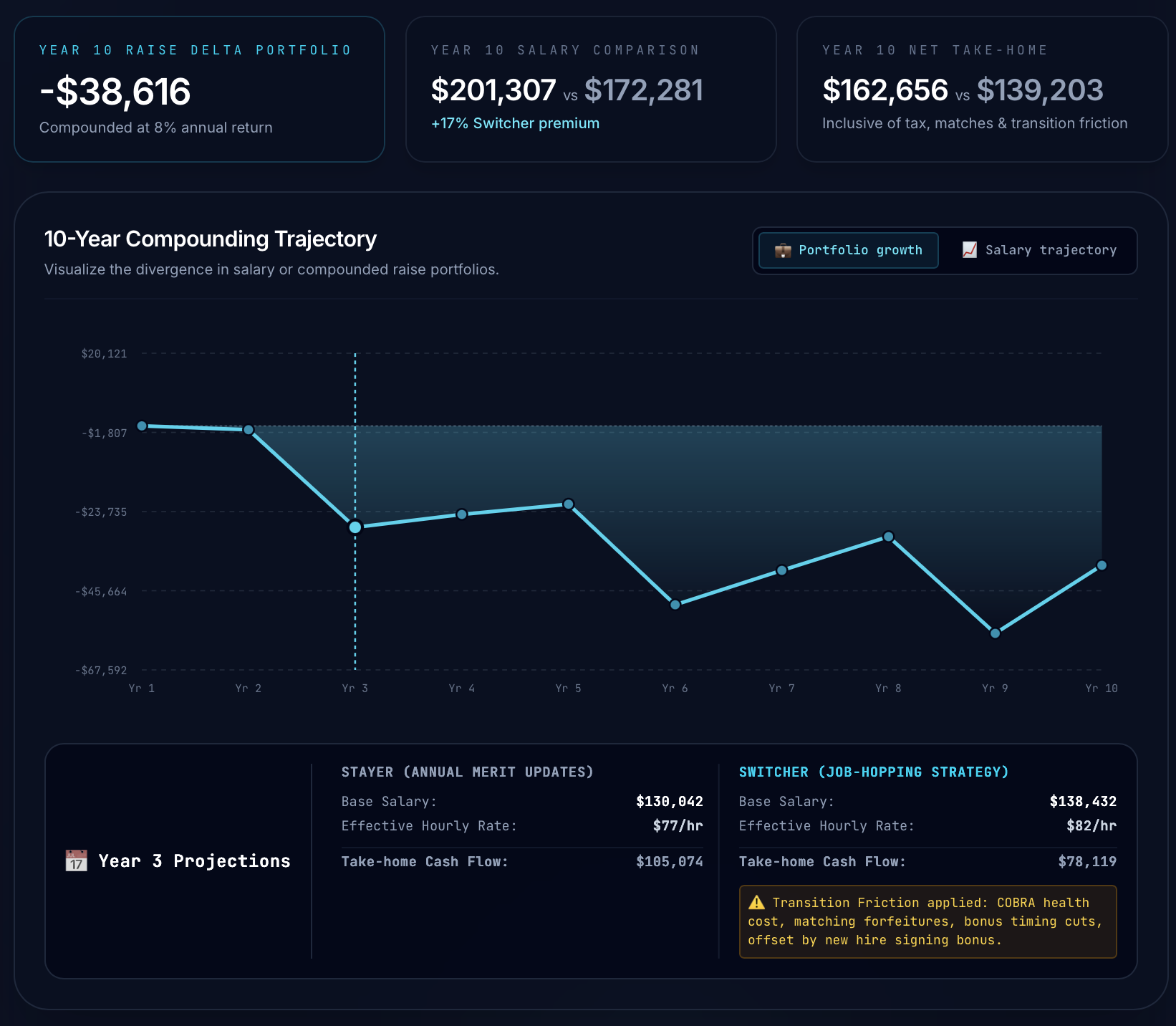
    Portfolio GrowthSalary Trajectory

    How to Use the Calculator as a Negotiation Tool

    The Exact Number You Need to Ask For

    Here’s the thing about calculators that actually work for a jobs switch—they tell you the precise dollar figure that makes the move worth it. Not a vague “ask for more” but a real, hard number. In our earlier scenario, the engineer at $120,000 faces a major hurdle.

    $5,000 signing bonus only yields $3,400 after-tax (leaving him with the $27,000 deficit).

    Jumping ship for a 12% raise sounds great until you realize you’re forfeiting over $21,000 in unvested employer matches. To make this move truly profitable, the engineer shouldn’t just accept the 12% raise. They should use the calculator’s output to negotiate a higher signing bonus or a starting salary that offsets the $21,000 loss.

    To completely break even on this transition in Year 3, he would need to negotiate a signing bonus of at least $39,700 gross (to net $27,000 after 32% tax), or demand a higher base raise than 12%.

    I recommend presenting these numbers clearly to the hiring manager. You can say, “I am very excited about this role, but leaving my current firm means walking away from $21,000 in vested benefits. Can we bridge that gap with a sign-on bonus?” This moves the negotiation from a request for “more” to a request for “fairness.”

    Conclusion: Turn Your Jobs Switch into a Wealth-Building Move

    The Bottom Line: Know Your Numbers Before You Leap

    A bigger paycheck sounds good, but as we’ve seen, hidden costs can eat that raise alive. I have seen too many talented professionals take a step back financially because they didn’t do the math. By using a quantitative approach, you ensure that every career move is a step toward greater wealth.

    Don’t let the excitement of a new title blind you to the reality of your balance sheet. Use the tools

    FAQ

    Why is a 12% raise sometimes considered insufficient for a job switch?

    A 12% raise may not cover the ‘exit costs’ of leaving a current role, such as forfeited unvested 401(k) matches or pending bonuses. In many cases, these lost assets can take years to recover through the new salary alone.

    What is cliff vesting and how does it affect a career move?

    Cliff vesting is a schedule where you gain full ownership of employer contributions only after reaching a specific milestone, often three years. Leaving before this milestone means forfeiting the entire amount, which can create a significant financial deficit that a new salary must offset.

    How can I use the calculator’s data during salary negotiations?

    You can present the specific dollar value of your forfeited benefits to a hiring manager to justify a higher signing bonus or starting salary. This shifts the conversation from a subjective request to a data-driven negotiation aimed at bridging a documented financial gap.

    What are the common ‘friction costs’ associated with changing jobs?

    Friction costs include immediate expenses like COBRA premiums for health insurance, administrative fees, and the loss of prorated performance bonuses. These costs, combined with lost vesting, determine the ‘break-even’ point of a new job offer.

    Why might a ‘Stayer’ eventually outearn a ‘Switcher’ in the long term?

    While switchers get an initial bump, they often receive lower annual merit increases if they are hired at the top of their salary band. Over several years, the consistent, slightly higher raises and preserved benefits of a ‘Stayer’ can lead to a higher total net worth.

    What is the ‘Switching Deficit’ mentioned in the guide?

    The Switching Deficit is the point where a professional’s net income falls below what they would have earned by staying in their previous role. This typically occurs around Year 3 when the initial signing bonus and raise are outweighed by lower annual growth and lost retirement funds.


    References

    [1] • Unexpected modal handling 𝗙𝗿𝗮𝗺𝗲𝘀 & 𝗪𝗶𝗻𝗱𝗼𝘄𝘀 • Switching between frames • Nested frame handling •.

    [2] ### Vice President CWPMICH at College Works Painting (2009-11-01 – 2011-09-01) **President/Vice Pres.

    [3] ## Current Position **Network Engineer**

    •Upgradation of.

    [4] #TalentAcquisition #HRTech #EmployerBrand #AIinHR #RecruitingStrategy ### 3w The job market may be.

    [5] Let’s connect if you’re looking for someone who brings both technical expertise and fresh perspectiv.

  • Calculate Your Career Relocation Payback

    Calculate Your Career Relocation Payback

    A hidden $6,130 tax drag nearly sank one career relocation—until a 5.0-month payback calculator revealed a $1,203 monthly gain.

    Most career-relocation decisions overlook a hidden $6,130 tax drag—here’s how one software engineer turned a 5.0-month payback into a $1,203 monthly gain.

    💡

    For professionals evaluating a career relocation, a detailed financial analysis using a cost calculator reveals that seemingly attractive salary increases can be undermined by hidden costs like lease penalties and tax drag, but a precise payback period—such as just five months in a Maryland-to-California move—can validate the move’s long-term value.

    Short Answer

    In short: For professionals evaluating a career relocation, a detailed financial analysis using a cost calculator reveals that seemingly attractive salary increases can be undermined by hidden costs like lease penalties and tax drag, but a precise payback period—such as just five months in

    Key Takeaways

    • With Giniloh Relocation Payback & Tax Adjustment Modeler, you can calculate your specific payback period by dividing the total upfront costs of moving by the monthly increase in your net take-home pay to determine how long it will take to break even.
    • Negotiate for a tax gross-up provision in your relocation package to ensure your employer covers the federal and state tax liabilities triggered by moving expense reimbursements.
    • Account for the loss of federal tax deductions for moving expenses, as current laws treat most employer-provided relocation assistance as taxable income rather than a tax-free benefit.
    • Evaluate the impact of state-specific tax structures, such as local piggyback taxes or high marginal rates, which can significantly reduce the purchasing power of a nominal salary increase.
    • Prepare for the administrative complexity of filing partial-year tax returns in two different jurisdictions to avoid potential double taxation and ensure accurate income allocation.

    Introduction: The High-Stakes Gamble of Career Relocation

    The promise of a more prestigious title and a larger paycheck in a dynamic environment is hard to ignore. For a software engineer I advised several years ago, a move from Maryland to California offered a salary jump from $95,000 to $120,000. On paper, this looks like a clear 26.3% win, suggesting a substantial increase in purchasing power.

    However, as I dug deeper into the fiscal data, I realized this move involves variables that can quickly erase those gains. Career relocation is rarely just about gross income. It is a multi-layered transaction involving tax law, cost-of-living adjustments, and immediate cash needs. These factors often go overlooked during the initial excitement of a new opportunity.

    In my analysis of these transitions, I have found that the “nominal raise” is often a financial illusion. When moving between states with vastly different tax codes and housing markets, the “real wage” tells a different story. Understanding these hidden costs is essential for any professional considering a cross-country move in the current economic climate.

    The allure of the West Coast tech scene remains strong, but the economic friction of getting there has never been higher. As the labor market shifts and remote work options fluctuate, the decision to relocate has become a complex exercise in personal finance. For many, the “dream job” can inadvertently lead to a “nightmare budget” if the transition is not managed with surgical precision.

    This article helps you uncover the real payback period for this relocation offer example using the Giniloh Relocation Payback & Tax Adjustment Modeler,

    The Regulatory Framework of Relocation

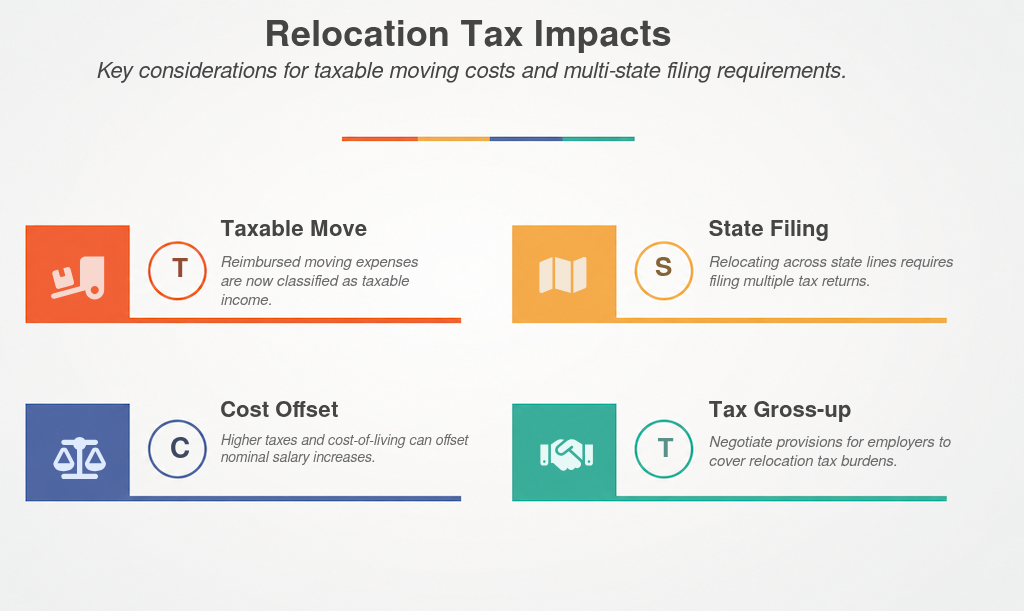
    Corporate relocation packages often cover moving services, temporary housing, or lease termination fees. While these perks help, federal tax changes have fundamentally altered their value. Under the Tax Cuts and Jobs Act (TCJA) of 2017, the federal treatment of moving expenses underwent a radical shift.

    What used to be a tax-free benefit is now a taxable liability for most employees. Previously, qualified moving expenses were deductible from gross income, and employer reimbursements were generally tax-free. This allowed workers to move without incurring a massive tax bill.

    However, under current federal law, the IRS treats these reimbursements as taxable income for the recipient. This applies regardless of whether the money went directly to a moving company or into the employee’s pocket as a lump sum. This legislative change means that every dollar a company spends to move your furniture is a dollar you are taxed on.

    Table 1: Federal Tax Treatment of Moving Expenses

    Expense Category

    Pre-2018 Status (TCJA)

    Current Status (Post-2018)

    Qualified Moving Expenses

    Deductible from Gross Income

    Non-Deductible (Suspended)

    Employer Reimbursements

    Tax-Free Benefit

    Taxable Income (W-2)

    Active-Duty Military

    Deductible

    Deductible (Exception)

    For a professional moving across the country, these costs can easily exceed $15,000. This creates a significant financial burden at a time when liquidity is already stretched thin. This shift creates a “tax drag” on the moving process that many fail to anticipate. The Giniloh Relocation Payback & Tax Adjustment Modeler considers these scenarios in the calculations.

    The Financial Implications of Professional Relocation

    Securing a professional offer in a new jurisdiction marks a significant career milestone. Yet, the financial reality of moving often extends far beyond the base salary listed on the contract. Financial advisors report that career-related moves involve complex fiscal challenges that many candidates overlook.

    While a higher salary appears advantageous, the actual economic impact depends on shifting factors. These include state tax mandates, federal legislative changes, and regional cost-of-living adjustments. These variables can quickly erode a nominal pay increase.

    The transition between states requires a technical approach to tax compliance. Professionals must manage the requirements of two distinct tax authorities, filing partial-year returns in both states. This process is rarely a simple division of income by months spent in each location.

    Instead, compliance involves the precise allocation of earnings, deductions, and credits based on specific residency dates. When moving between states with disparate tax structures, a “tax drag” often occurs. This phenomenon can significantly diminish the anticipated financial gains of a promotion.

    Infographic: The 2018 Tax Cuts and Jobs Act reclassified employer-reimbursed moving expenses as taxable income, i

    Taxation of Relocation Benefits and the TCJA

    The landscape of corporate relocation shifted with the implementation of the TCJA in 2018. Before this legislation, many moving expenses were deductible for the employee. They could also be reimbursed by the employer on a tax-free basis.

    This previous arrangement included the cost of transporting household goods and travel expenses. However, under current federal law, these reimbursements are treated as taxable wages. This change means a relocation package valued at $20,000 is no longer a net benefit of $20,000.

    Instead, the IRS views that amount as gross income subject to federal, state, and FICA taxes. For a professional in a high tax bracket, this creates a liability of several thousand dollars. This debt must be settled during the following tax season.

    Analysts suggest that without a “gross-up” provision, the employee effectively pays for their own relocation through increased withholding. In a gross-up scenario, the employer provides additional funds specifically to cover these taxes.

    This ensures the employee receives the full intended value of the assistance. The IRS maintains strict reporting requirements for these benefits, and employers must include them on the W-2 form. This increase in reported income can have secondary effects on a taxpayer’s filing, such as triggering the phase-out of certain tax credits.

    Decoding Career Relocation Assistance: What Job Postings Actually Offer

    For many relocating professionals, the promise of a corporate-funded move suggests a seamless transition. However, industry data shows that the “sticker price” of a package rarely matches the actual net benefit.

    In the current labor market, the gap between a gross offer and take-home reality can be vast. Understanding the contractual nuances of these agreements is no longer optional. It is a requirement for maintaining financial stability during a cross-country move.

    Economic

    Relocation

    analysts suggest that the “Great Relocation” trend has shifted how companies view mobility. While remote work initially slowed corporate moves, return-to-office mandates have revitalized the industry. This resurgence has brought a renewed focus on the complex financial instruments used to move talent.

    Table 2: Common Relocation Assistance Models

    Model Type

    Financial Responsibility

    Employee Flexibility

    Lump-Sum Payment

    Employee manages fixed cash amount

    High

    Direct Billing

    Employer pays vendors directly

    Low

    Managed Move

    Full-service coordination by employer

    Medium

    Reimbursement

    Employee fronts costs, submits receipts

    High

    The Architecture of Modern Relocation Assistance

    In the contemporary corporate landscape, career relocation packages are far from uniform. While recruiters use the term as a generic benefit, the structure varies based on seniority and industry norms. Most packages fall into four distinct categories: lump-sum, direct billing, managed moves, and reimbursement.

    The lump-sum payment is the most frequent choice for entry-to-mid-level roles. In this model, the employer provides a set amount of cash upfront to cover all expenses. This offers flexibility but shifts the entire logistical and financial risk to the individual.

    Industry reports indicate that lump-sum payments are increasingly popular among HR departments. However, for the employee, these payments are often treated as supplemental wages. This means they are subject to immediate tax withholding, reducing the actual cash available for moving.

    Direct billing is often preferred by those looking to minimize out-of-pocket stress. Here, the company pays service providers—such as moving companies and airlines—directly. This model reduces the immediate financial burden but limits the ability to choose specific vendors.

    The Tax Drag Reality: How State Rules Eat Into Your Raise

    Salary negotiations usually center on the headline figure—the gross annual pay. However, for professionals moving across state lines, that number is often a poor indicator of take-home pay. The financial reality is frequently buried in the friction between disparate state tax codes.

    Many workers only discover the true cost of a “raise” after their first paycheck arrives. By then, the move is complete and the lease is signed. What looked like a significant step forward can quickly become a lateral move once the government takes its share.

    The administrative burden of these moves is equally taxing. Relocating professionals must navigate the complexity of filing partial-year tax returns in two different states. This process requires a meticulous, day-by-day apportionment of income and credits.

    This dual-filing requirement represents a tangible financial risk. When two states have conflicting definitions of residency, the risk of double taxation becomes a reality. For the unprepared, these hidden costs can turn a career milestone into a source of immediate stress.

    The Comparative Tax Landscape: Maryland vs. California

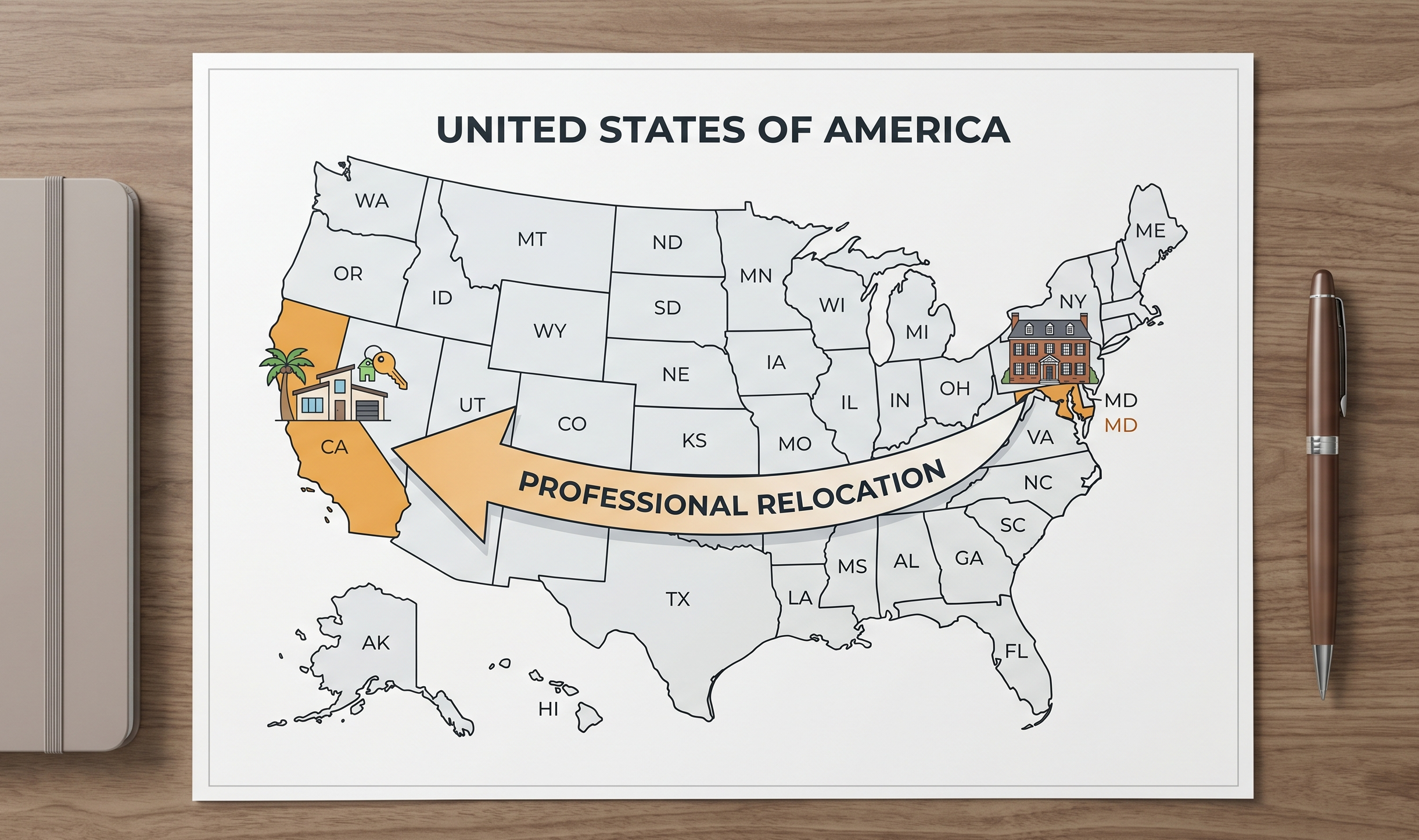
    A common scenario involves a software engineer moving from Maryland to a tech hub in California. In this case, the professional transitions from a $95,000 salary to a $120,000 salary. On the surface, this 26% increase suggests a significant improvement in lifestyle.

    Relocating from MD to CA

    However, the shift in tax regimes tells a more complicated story. Maryland’s tax structure is unique due to its “piggyback” system. While the state income tax rate is moderate, local jurisdictions levy their own income taxes on top of the state rate.

    In high-population areas like Montgomery County, the local rate is typically 3.2%. When combined with the top state marginal rate of 5.75%, a resident can face a combined rate of nearly 9%. This local levy is a significant factor that many out-of-state recruiters fail to account for.

    Table 3: Maryland vs. California Tax Comparison ($120k Salary)

    Tax Component

    Maryland (Est.)

    California (Est.)

    State Marginal Rate

    5.75%

    9.30%

    Local/County Tax

    Up to 3.20%

    0.00%

    Combined Marginal Rate

    ~8.95%

    ~9.30%

    Giniloh Interactive Calculator Walkthrough: From Lease Break to Net Gain

    Financial Analysis of Career-Based Relocation

    The prospect of a $25,000 salary increase often serves as a primary catalyst for relocation. On paper, a jump from $95,000 to $120,000 represents a 26.3% nominal raise. However, raw salary data rarely tells the complete story of a cross-country move.

    Journalistic analysis suggests that gross figures frequently mask the complex reality of net income adjustments. When moving between distinct fiscal environments, the “raise” can be eroded by localized obligations. These factors often turn a perceived windfall into a break-even scenario.

    To quantify these variables, the Interactive Relocation Calculator provides a framework for assessment. The tool moves beyond simple cost-of-living comparisons to examine specific “leakage” during a transition. This includes everything from pro-rated rent to specific state tax treatments.

    In the current economic climate, the “salary illusion” remains a significant hurdle. This phenomenon occurs when an individual focuses on a higher gross number while ignoring increased costs. The following analysis examines the financial friction points of moving from the Mid-Atlantic to the West Coast.

    Establishing the Baseline: The Maryland Fiscal Environment

    The initial phase of any relocation assessment requires a precise accounting of current standing. In this scenario, the baseline is established using a single filing status in Maryland. This state serves as a complex starting point due to its multi-layered approach to taxation.

    Unlike states with a flat tax, Maryland employs a multi-tiered fiscal structure. A critical component is the local “piggyback” tax, which is collected by the state but distributed to counties. For an individual earning $95,000, this local assessment represents a significant deduction.

    The Interactive Relocation Calculator utilizes these specific parameters to determine the current “take-home” baseline. By entering a $95,000 salary, the tool accounts for federal tax, Social Security, and specific Maryland brackets. This creates a realistic picture of what the professional actually sees in their bank account.

    In this example, you can enter the baseline as follows:

    1. Filing Status & Origin Inputs: Select Single. Set Origin State to Maryland. Set Origin Local Rate to 3.2%. Enter Origin Base Salary as 95000.

    2. Destination Inputs: Set Destination State to California. Input Destination Base Salary as 120000. Note that the state exceptions indicator lights up green because California excludes qualified moving costs from state taxable income.

    The Relocation & Lease Break Friction

    This breakdown explains the hidden financial costs (the “friction”) of breaking a current lease and moving across the country for a new job.

    Lease Break Setup: Navigate to the Lease Break tab. Enter rent details: Monthly Rent 2200, Days Occupied 12. Enter Penalties 3500, Lost Deposit 1500, and Employer Allowance 2000.

    * Qualified Transit Expenses: $1,800 packing/loading + $1,200 truck rental + $800 flights (all employer-reimbursed).

    * Tax Status: Physical transit reimbursements ($3,800) are fully taxable federally under OBBBA rules, creating a state-level tax liability difference (tax drag) since California excludes qualified expenses.

    Mastering State-Specific Tax Nuances: AB 692 and OBBBA Explained

    Here’s a hard truth about job offers that include relocation: the number on your offer letter isn’t the number you’ll take home. Most people don’t realize this until they see their first paycheck. Job boards and generic career advice sites completely ignore this reality.

    In my experience, the technicalities of state-specific laws like California’s AB 692 can catch even seasoned professionals off guard. These regulations dictate how income is sourced and taxed during the transition year. Failing to account for these nuances can lead to unexpected liabilities during tax season.

    Furthermore, historical frameworks like the Omnibus Budget Reconciliation Act (OBBBA) have shaped how we view fiscal responsibility in relocation. While the names of the laws change, the principle remains the same. The government views your move as a taxable event, not just a career step.

    Calculating Your Break-Even: The Payback Period Formula

    Crunching the Real Numbers: The $6,130 Leap of Faith

    Alright, let’s stop talking in hypotheticals and get our hands dirty with some actual math. For a career relocation from Maryland to California, the upfront sting is very real. Between lease breaks, moving vans, and security deposits, the initial costs can be staggering.

    I often tell my clients to calculate their “Payback Period.” This is the number of months it takes for your new, higher net income to cover the total cost of the move. If your move costs $15,000 and your monthly net increase is only $500, it will take you 30 months just to break even.

    In our software engineer scenario, the upfront costs totaled approximately $6,065. When you factor in the higher California taxes and cost of living, the “raise” feels much smaller. It is vital to know if you are moving for a better life or just a bigger tax bill.

    Turning Data into Action: Negotiating Smarter and Planning Ahead

    When the Offer Isn’t a Slam Dunk

    So you’ve run the numbers. The calculator spits out a break-even of 5.0 months for that leap from Maryland to California. Seems good, right? But gazing at a raw number is like looking at a map without knowing where the potholes are.

    I recommend using this data as leverage during your final negotiations. If the “tax drag” is going to cost you $5,000, ask for a signing bonus to offset it. Most companies have “relocation buckets” that are separate from salary budgets, making these requests easier to grant.

    Don’t just accept the standard package. If you know your lease break is going to be expensive, ask for that specific cost to be covered. Being armed with precise data makes you a more formidable negotiator and ensures your career relocation is a true financial gain.

    Conclusion: Beyond the Paycheck

    So you’ve run the numbers on that shiny new job offer. Now what? Here’s the truth about career relocation: it’s never just about the salary bump. The hidden costs—tax drag, lease penalties, and state-specific rules—can quietly eat into your raise.

    In my years of tracking these transitions, I’ve seen that the most successful moves are those planned with a cold, analytical eye. Don’t let the excitement of a new city blind you to the reality of your bank account. Take the time to calculate your real net gain before you sign on the dotted line.

    Ultimately, a move should propel your career and your finances forward simultaneously. By understanding the regulatory landscape and negotiating for gross-ups, you can ensure your next big move is a win. Your career is an investment; make sure the relocation pays off.

    FAQ

    Are employer-reimbursed moving expenses considered taxable income?

    Yes, under the Tax Cuts and Jobs Act of 2017, most employer-provided moving reimbursements are treated as taxable wages. This means the value of your relocation package is reported on your W-2 and is subject to federal, state, and FICA taxes.

    What is a tax gross-up provision in a relocation agreement?

    A tax gross-up is a provision where the employer provides additional funds to cover the tax liability generated by relocation benefits. This ensures the employee receives the full intended value of the assistance without a reduction in take-home pay due to increased withholding.

    How is the relocation payback period calculated?

    The payback period is calculated by dividing the total upfront costs of the move, such as lease penalties and moving services, by the monthly increase in your net take-home pay. This figure represents the number of months required for the new salary to fully offset the initial expenses of the transition.

    What are the primary differences between a lump-sum payment and direct billing?

    A lump-sum payment provides a fixed cash amount for the employee to manage, offering high flexibility but shifting all logistical risk and tax withholding to the individual. Direct billing involves the employer paying vendors directly, which reduces out-of-pocket stress but limits the employee’s choice of service providers.

    How does moving between states affect tax filing requirements?

    Relocating across state lines typically requires filing partial-year tax returns in both the origin and destination states. This process involves a precise, day-by-day allocation of income, deductions, and credits to ensure compliance with two distinct sets of state tax mandates.

    Why might a significant salary increase result in a “lateral move” financially?

    A nominal salary increase can be eroded by “tax drag” and regional cost-of-living adjustments, particularly when moving to a state with higher marginal tax rates. If the increase in net income is minimal compared to the higher costs of housing and local taxes, the professional’s actual purchasing power may remain unchanged.


    References

    [1] The qualifications to get a job as a relocation consultant include knowledge of the area in which yo.

    [2] Your other job duties include consulting with the relocating employees to understand their needs, ma.

    [3] Your other job duties include consulting with the relocating employees to understand their needs, ma.

    [4] Browse 1000+ RELOCATION CONSULTANT jobs ($24-$92/hr) from companies with openings that are hiring no.

    [5] The possibility of a lower cost of living may be the best factor to use when considering location an.

  • Negotiate Job Offer with Giniloh Visualizer

    Negotiate Job Offer with Giniloh Visualizer

    Key Takeaways

    • Evaluate the entire financial package, including equity, bonuses, and benefits.
    • Account for external factors such as regional cost-of-living differences and the tax implications of various compensation types to determine the true take-home value of an offer.
    • Secure a formal written offer before initiating negotiations and frame counteroffers as collaborative discussions to maintain rapport while leveraging data to justify requests.
    See every dollar of your job offer—salary, equity, perks—and negotiate with data-driven confidence.

    What if you could visualize the long-term impact of every element in a job offer before you negotiate?

    💡

    Mastering how to negotiate a job offer requires more than generic advice—by leveraging a total compensation visualizer to compare salary, equity, and benefits side by side, candidates gain objective data and confidence to justify stronger counteroffers and secure the best possible package.

    Short Answer

    In short: Mastering how to negotiate a job offer requires more than generic advice—by leveraging a total compensation visualizer to compare salary, equity, and benefits side by side, candidates gain objective data and confidence to justify stronger counteroffers and secure the best possibl

    Why Total Compensation Trumps Base Salary in Negotiations

    The Evolution of Total Compensation in Modern Employment

    When I first sat down to negotiate a job offer early in my career, I was laser-focused on one number: the base salary. I believed that a higher starting pay was the ultimate sign of success, ignoring the complex web of benefits and equity that actually build long-term wealth. I soon realized that by ignoring the “whole envelope,” I was leaving thousands of dollars on the table.

    The traditional focus on base salary is increasingly viewed as an incomplete metric for evaluating professional opportunities. While the base salary remains the most visible component, it represents only a single segment of a comprehensive financial package. It serves as the primary source of liquidity for immediate expenses, but it rarely tells the full story of a role’s value.

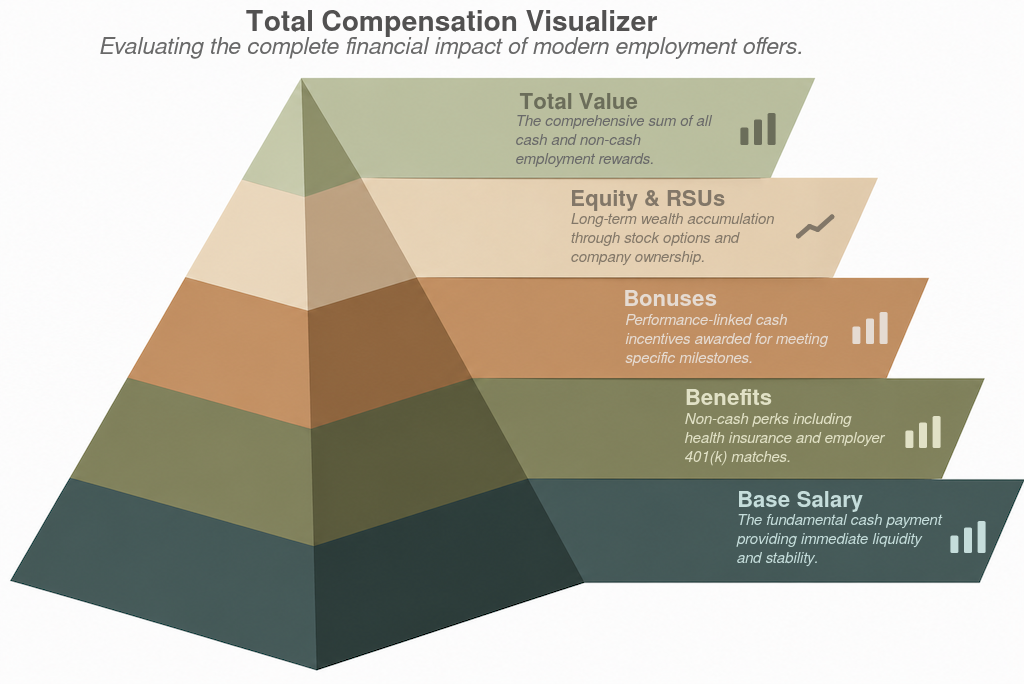
    Total compensation is a term encompassing the aggregate value of all cash and non-cash rewards provided to an employee and it is the core of the GiniLoh Total Compensation Visualizer. Total compensation includes base pay, annual performance bonuses, equity or stock options, and retirement contributions. It also accounts for health insurance premiums, paid time off, and various fringe benefits.

    Infographic: The Evolution of Total Compensation in Modern EmploymentWhen I first sat down to negotiate a job off

    Understanding the Financial Impact of Non-Cash Rewards

    Failure to account for these additional variables can result in a significant undervaluation of an offer. Candidates often overlook thousands of dollars in annual value by focusing solely on the monthly paycheck. This oversight is particularly common among early-career professionals who may not yet appreciate the long-term impact of employer-sponsored benefits.

    The complexity of modern compensation structures reflects a shift in how corporations attract and retain talent. Beyond the standard paycheck, employers utilize diverse financial instruments to align employee interests with company performance. This alignment is designed to foster a sense of ownership and long-term commitment among the workforce.

    Component

    Type

    Financial Impact

    Base Salary

    Cash

    Immediate liquidity and multiplier for benefits.

    Equity/RSUs

    Asset

    Long-term wealth accumulation and ownership.

    Bonuses

    Variable Cash

    Performance-linked income.

    Benefits

    Non-Cash

    Reduces out-of-pocket costs (Health, 401k).

    Data from a recent NerdWallet survey suggests that ancillary benefits can augment an individual’s real earnings by 30% or more. These benefits include employer-sponsored 401(k) matches and performance-based bonuses that trigger upon meeting specific milestones. Such figures highlight why a lower-salary offer with high benefits can often outperform a high-salary offer with no perks.

    The Role of Analytical Tools in Offer Evaluation

    Comparing competing job offers has historically been fraught with ambiguity. This is particularly true when comparing roles across different industries or geographic regions with varying costs of living. The introduction of the job offer calculator has transformed this subjective exercise into a data-driven discipline.

    Digital tools, such as Giniloh’s Total Compensation Visualizer, allow candidates to input specific variables to generate a side-by-side comparison. These variables include base salary, the fair market value of equity grants, target bonus percentages, and the estimated cash value of health benefits.

    Utilizing a job offer comparison tool also facilitates a clearer understanding of the trade-offs inherent in different corporate structures. For instance, early-stage startups frequently lack the capital to compete with established multinational corporations on base salary. They compensate by providing generous equity packages that carry the potential for significant financial upside.

    Visualizing the “Shape” of Your Wealth

    Established firms may offer lower equity upside but provide greater stability and more robust immediate benefits. These might include higher 401(k) matches or fully subsidized premium health insurance plans. By visualizing these numbers, you, as a candidate can move away from intuitive decision-making and toward an objective analysis.

    Taxes

    The GiniLoh Total Compensation Visualizer also accounts for the “tax-drag” on different types of compensation. While a bonus is taxed as supplemental income, certain health benefits are provided tax-free. Understanding these distinctions allows a candidate to calculate their true “take-home” value.

    Comparison Method

    Ease of Use

    Accounting for Taxes

    Real-Time Analysis

    Mental Math / Gut Feel

    High (but inaccurate)

    No

    No

    Manual Spreadsheet

    Low (error-prone)

    Possible, but complex

    No (static)

    Basic Calculator

    Medium

    Often ignores tax nuance

    Limited

    Visualizer (Simulation)

    High

    Yes (with regional data)

    Yes — immediate

    Data-driven evaluation also helps in identifying “hidden” costs associated with a new role. A calculator might reveal that a longer commute or a higher-cost insurance plan effectively cancels out a 5% raise. This level of detail empowers professionals to make moves that actually improve their financial standing.

    Step-by-Step: Input Your Numbers and See the Real-Time Impact

    Analyzing the Job Offer: A Comprehensive Approach

    Receiving a formal job offer is a defining moment, yet the evaluation process is often surprisingly flawed. Many focus narrowly on immediate liquidity, viewing the base salary as the primary measure of success.

    The headline salary is merely one component of a complex financial contract that requires deeper inspection. To accurately judge an offer, you must move beyond a cursory glance at the monthly paycheck. A rigorous analysis of Total Compensation Value (TCV) is necessary to understand the long-term trajectory.

    Failing to account for the full spectrum of benefits can lead to a significant undervaluation of professional worth. This oversight often results in missed opportunities for wealth accumulation. Industry research suggests that a comprehensive understanding of compensation structures is the most effective way to secure a fair agreement.

    The first stage in evaluating a professional offer is identifying every financial element in the contract. A common mistake is underestimate benefits that do not appear in the monthly deposit but impact net worth. To build an accurate TCV model, you must categorize and quantify several distinct streams of value.

    offer letter

    A systematic inventory requires a meticulous review of the offer letter, the benefits summary, and the equity plan documents. Often, the most valuable details are buried in the fine print of an appendix. Candidates should approach this task with the mindset of an auditor, ensuring no potential revenue stream is omitted.

    Base Salary: The Foundation of Recurring Income

    The base salary serves as the floor for an employee’s financial security. It is the guaranteed portion of the contract, unaffected by market volatility or company performance. For many, this figure dictates their ability to secure mortgages and manage daily expenses.

    Items such as 401(k) matches and life insurance coverage are frequently calculated as a percentage of this base. When evaluating the base, it is essential to consider the local cost of living. A $150,000 salary in San Francisco may offer less purchasing power than $110,000 in a mid-sized city.

    City

    Nominal Salary

    Cost of Living Index

    Estimated “Real” Value

    San Francisco

    $150,000

    Very High

    $95,000

    Austin

    $130,000

    Moderate

    $115,000

    Raleigh

    $110,000

    Lower

    $105,000

    Simulating Negotiation Scenarios: Salary vs. Equity vs. Bonuses

    The Strategic Calculus of Tech Compensation

    The initial phone call from a recruiter often centers on a single, enticing number: the base salary. In the high-stakes world of technology, however, that figure is rarely the full story. Industry analysts point out that the most lucrative deals are often hidden in the fine print of equity grants and multipliers.

    Evaluating an offer requires a fundamental shift in perspective. It is no longer about the monthly paycheck alone. Instead, candidates are increasingly adopting a multi-year financial lens to decode what a role is actually worth over the long haul .

    Market data from the past three years shows a clear and consistent trend. For mid-to-senior level roles at firms like Meta or Google, non-salary components frequently make up 30% to 60% of the total value. In some executive tiers, the base salary is merely a fraction of the realized wealth.

    Quantifying the Trade-Offs You Can’t See Yet

    Most professionals enter a negotiation with an “anchor” number in mind based on what they earned previously. However, focusing on this single data point can lead to poor long-term financial decisions

    Consider a $120,000 base salary offer. On the surface, it looks superior to a $110,000 offer. But if the latter includes a $20,000 signing bonus and a $100,000 equity grant vesting over four years, the math changes instantly. The second offer is worth significantly more in “effective” annual income.

    Mastering Negotiation Tactics with Giniloh Total Compensation Visualizer (TCV)

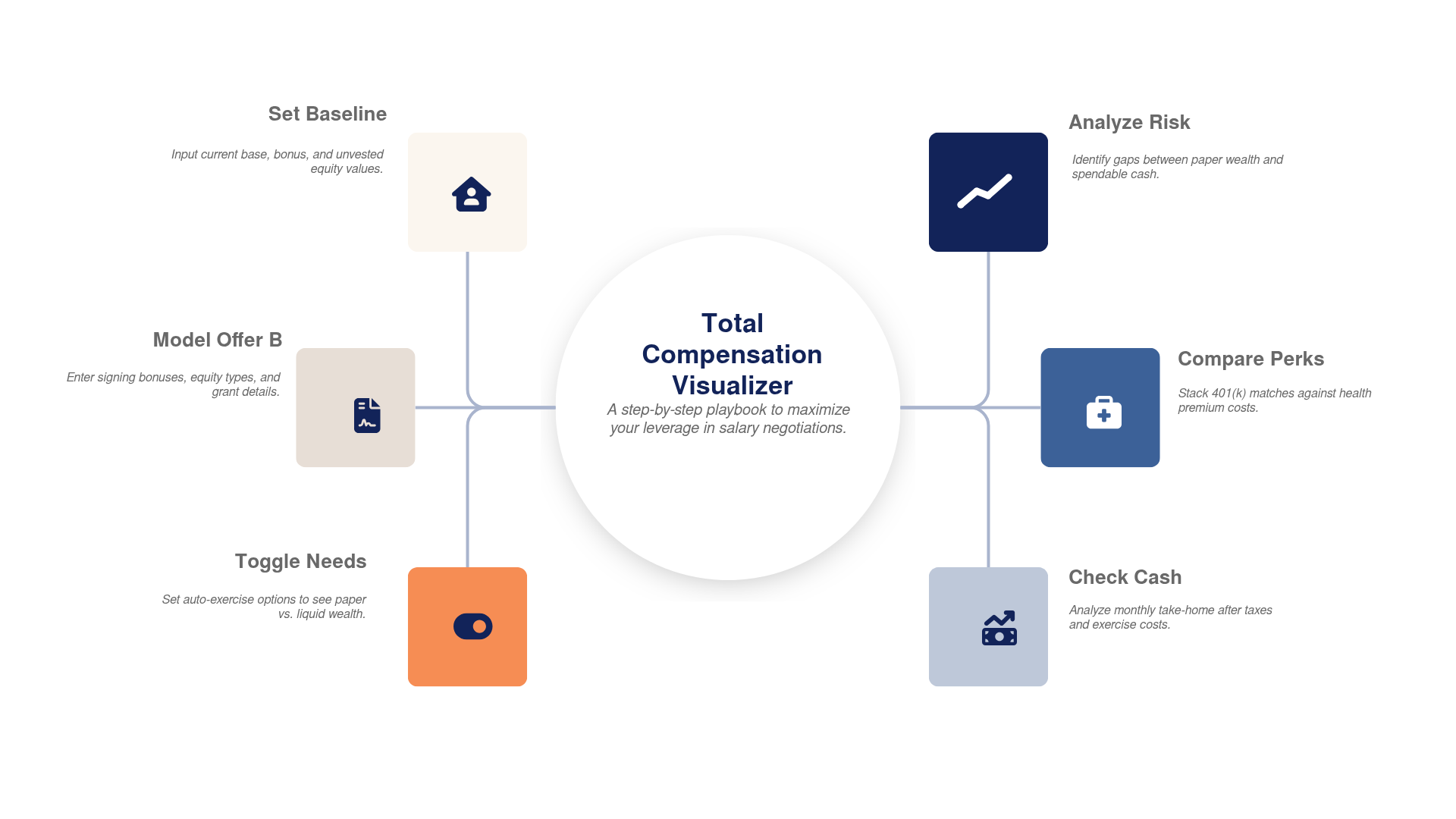
    The Total Compensation Visualizer (TCV) converts abstract equity and benefits packages into clear, year-by-year cash flows and wealth engines. By modeling your current role as Offer A and your new offer as Offer B, you gain the exact data needed to drive a highly strategic, numbers-backed negotiation. Here is your step-by-step playbook to maximize your leverage:

    Infographic: The Total Compensation Visualizer (TCV) converts abstract equity and benefits packages into clear, y

    Step 1: Establish the Baseline (Current Job as Offer A)

    First, you enter your current compensation structure to establish a realistic baseline.

    • Cash: Input current base salary and target bonus.

    • Long-Term Incentives (LTIP): Input only the remaining unvested stock units or options you expect to vest over the next 4 years. (Already-vested equity belongs in your personal net worth, not in a forward-looking comp comparison).

    • Perks: Input your current 401(k) matching, ESPP yield, average unused PTO days, and health premium deductions.


    Step 2: Model the New Offer (as Offer B)

    Next, you input the competing offer details.

    • Upfront Incentives: Input signing bonuses or relocation allowances.

    • Equity Details: Choose the correct equity type (e.g., Public Stock Unit vs. ISO Options), inputting the grant price and current value.

    • Global Toggles: Ensure Auto-Exercise Options is toggled ON if you intend to exercise options as you vest, or OFF to see how much paper wealth you accumulate without cash drain.


    Step 3: Analyze the Gaps

    With both columns filled, you review the charts and metrics cards to uncover the real trade-offs:

    1. The Net Spendable Cash Flow Line: Does the new offer actually put more cash in your bank account each month, or does tax drag and option exercise cost erode the paper raise?

    2. The Perks Deficit: A higher base salary can be quietly canceled out by worse benefits. The TCV Perks Value positive stack and Out-of-Pocket Drag negative stack will show if premium healthcare costs or lack of ESPP are dragging down your earnings.

    3. The Illiquidity Risk: If the new offer is option-heavy, the Total Paper Wealth card will show high numbers, but the 4-Yr Spendable Cash will show a massive gap compared to your current job.


    Step 4: Negotiate with Data-Driven Leverage

    Instead of asking for a generic “Can you do 10% more on the base?”, you can use specific mathematical findings from the TCV to negotiate from a position of authority:

    negotiating

    1. Bridging the Benefits & Vacation Gap (Perks Deficit)

    The Script: “At my current company, I receive a 6% 401(k) match and 25 days of paid vacation. Looking at your current benefits package, the difference in retirement match and PTO time adds up to a gap of about $12,000 per year. To help bridge that gap and make the transition seamless, would you be open to increasing the annual stock grant by $15,000?”

    • Why this works: It replaces dense HR terminology like perks deficit or match cap with straightforward concepts like retirement match and vacation difference. By assigning a concrete dollar value to these missing perks, you ground the request in math rather than emotion, making it easy for the recruiter to justify a higher equity grant to leadership.

    2. Offsetting the Cost to Buy Stock Options (Option Exercise Drag)

    The Script: “Because the stock options in this offer aren’t liquid cash and require an out-of-pocket cost to exercise as they vest, it will cost me roughly $20,000 over the next four years to buy them. To help offset that upfront cash commitment, would it be possible to add a $25,000 sign-on bonus?”

    • Why this works: Instead of using complex financial terms like illiquid assets or capital drag, this explanation frames the reality plainly: stock options are a future opportunity, but they require a cash layout today. Proposing a sign-on bonus is a highly effective counter because it addresses your immediate cash-flow needs without altering the company’s long-term salary structure.

    3. Offsetting the Stock Grant Tax Bill (RSU Tax Shortfall)

    The Script: “Because public company stock grants are automatically withheld at a flat supplemental tax rate of 22%, my actual tax bracket means I’ll be facing an additional tax bill of about $6,500 every year when I file. To help ensure my predictable monthly take-home cash stays steady, could we look at raising the base salary by $10,000?”

    • Why this works: It translates technical tax jargon like sell-to-cover withholding rates and underwithholding shortfalls into a practical, real-world scenario. It clearly demonstrates that while the total compensation looks high on paper, the automatic withholding structure creates a cash-flow dip. Anchoring this gap to your base salary solves the problem permanently rather than with a one-time fix.

    Pro-Tips for Delivering These Scripts:

    • The “Buffer” Rule: Notice that in every script, the ask is slightly higher than the actual gap ($15k ask for a $12k gap; $25k ask for a $20k gap). This leaves you room to compromise while still covering your baseline.

    • Tone is Everything: Deliver these with a collaborative, “help me solve this puzzle” energy rather than a demanding one. Recruiters love solving clear, numerical problems.

    Conclusion: Your Next Steps to Secure the Best Offer

    So, here’s the thing about learning how to negotiate a job offer: generic advice gets you nowhere. “Just ask for more,” they say. But more of what? Base salary? Equity? A signing bonus? The Giniloh Total Compensation Visualizer (TCV) changes all of that by providing the data you need to make an informed decision.

    FAQ

    Why is total compensation more important than base salary alone?

    Total compensation includes the aggregate value of salary, bonuses, equity, and benefits, which can account for 30% or more of your real earnings. Focusing only on base salary ignores long-term wealth accumulation and the significant financial impact of non-cash rewards.

    How does a compensation visualizer assist in the negotiation process?

    A visualizer allows you to compare different offers side-by-side using objective data rather than intuition. It helps you see the true value of an offer by accounting for variables like tax-drag, vesting schedules, and the cash value of health benefits.

    Should I negotiate before or after receiving a written offer?

    You should always wait for a formal written offer before initiating detailed compensation discussions. A written document provides the fixed parameters and legal weight necessary to evaluate complex components like equity and vesting schedules accurately.

    How do equity grants impact the long-term value of a job offer?

    Equity grants, such as RSUs or stock options, can significantly increase your effective annual income over several years. While they carry more risk than cash, they offer long-term wealth potential that often outweighs a slightly higher base salary.

    Can a lower salary offer actually be more valuable than a higher one?

    Yes, an offer with a lower base salary can be superior if it includes robust benefits like full health insurance coverage, high 401(k) matching, or significant signing bonuses. These benefits reduce out-of-pocket costs and increase your overall net worth.

    What role does the cost of living play in evaluating an offer?

    The cost of living is a critical multiplier that determines your actual purchasing power. A high nominal salary in an expensive city may result in less real value than a lower salary in a more affordable region.

    How can I maintain a positive relationship with a recruiter while negotiating?

    Frame the negotiation as a collaborative problem-solving exercise rather than a series of aggressive demands. Leading with genuine enthusiasm for the role builds the social capital needed to justify your counteroffer.

    What are common hidden costs to look for in a new job offer?

    Hidden costs include factors like longer commutes, higher insurance premiums, or lower retirement matches that can cancel out a salary increase. Identifying these through a data-driven evaluation ensures your move actually improves your financial standing.


    References

    [1] # France Salary Comparison Calculator – Daily Income 2026 This Daily Salary Comparison Calculator.

    [2] ## Evaluating Salary Packages Using Hourly Take-Home Pay Job offers in France often include differ.

    [3] # Washington Annual Salary Comparison Calculator 2026 The Annual Salary Comparison Calculator prov.
    [4] # Sint Maarten Salary Comparison Calculator – Monthly Income 2026 This Monthly Salary Comparison C.
    [5] # Ireland 2026 Daily Take-Home Pay Comparison Calculator Use the Daily Salary Comparison Calculato.

    [6] # Ireland Hourly Salary Comparison Calculator 2026 The Hourly Salary Comparison Calculator provide.

    [7] ## Assess Employment Offers with Salary After Tax Comparisons Choosing between job opportunities i.

    [8] The salary comparison calculators on this page are designed to allow you to calculate and compare in.

  • The Blueprint Behind Giniloh Money Flow

    The Blueprint Behind Giniloh Money Flow

    Test your smart money decisions risk-free and watch your money flow automate in real time—no spreadsheets needed.

    What if you could simulate every financial decision before risking a single dollar—and watch your money flow in real time without the spreadsheet stress?

    💡

    By simulating your money flow in real time, you can make smarter money decisions without the risk—turning guesswork into automated, stress-free control over your finances.

    Short Answer

    In short: By simulating your money flow in real time, you can make smarter money decisions without the risk—turning guesswork into automated, stress-free control over your finances.

    Key Takeaways

    • Transitioning from reactive tracking to proactive simulation allows you to anticipate future financial obstacles and avoid the stress of payday panic.
    • Automating your money flow reduces decision fatigue by eliminating the need for constant manual transfers and repetitive mental math.
    • Utilizing a risk-free sandbox environment lets you test various financial scenarios and fire drills without the danger of real-world penalties or overdraft fees.
    • Incorporating regulatory guardrails into your financial planning ensures that your automated strategies remain compliant with tax laws and contribution limits.
    • Visualizing your finances as a forward-looking map helps you understand exactly how today’s spending decisions will impact your future balance weeks in advance.

    Introduction: Why Your Money Flow Needs a Test Drive

    At giniloh.com, we built the Money Flow Simulator to help users understand money flows in both personal and enterprise scenarios. Personally, I used to panic during bear markets or bad economic news—and that fear cost me real dollars. This tool has helped me pause and ask myself the right questions before making any fear-driven decision.

    I’ve been thinking a lot about money lately. Not just how much is in my bank account, but where it actually goes. You know that feeling when payday arrives and somehow, before you’ve even blinked, the balance has magically disappeared?

    I’ve been there more times than I’d like to admit. It’s that weird, sinking feeling in your stomach when you look at your phone, see a double-digit balance, and realize you still have ten days left until the next check hits.

    The Payday Vanishing Act

    I used to call it the “payday vanishing act,” and honestly, it felt like a curse I couldn’t break. I would work forty or fifty hours a week, feel like I was being responsible, and then suddenly find myself scrounging for change to buy gas on a Tuesday morning.

    It wasn’t that I was buying Ferraris or gold watches; it was just that my money seemed to have a mind of its own. It was like trying to hold water in my cupped hands—no matter how tight I squeezed my fingers, it just kept leaking out.

    Here’s what I’ve realized: your money flow—the way cash moves in and out of your life—is everything. It’s the quiet engine running behind every bill payment, every latte, and every savings deposit.

    Shifting from Reactive to Proactive

    Most of us manage our money backward. We react to what’s already happened, checking our accounts after the fact and wondering where it all went. We treat our bank accounts like a rearview mirror, looking at yesterday to guess what we can do today.

    Calculating what is left from salary

    But if you’re driving a car, you don’t just look in the rearview mirror. You need to see the road ahead. You need to know if there’s a giant pothole coming up in three weeks that’s going to pop your financial tires.

    Management Style Focus Outcome
    Reactive Past transactions and current balance Stress, overdrafts, and “payday panic”
    Proactive (Money Flow) Future pipelines and automated sweeps Clarity, growth, and financial peace

    The Problem with Guessing Your Way Through Finances

    I used to juggle everything manually. I’d transfer a bit to savings, hope I didn’t hit my overdraft, and cross my fingers that the credit card payment would clear before rent came out.

    It was a constant game of mental math that I was usually losing. I’d be standing in the grocery store aisle, staring at a bag of fancy coffee, trying to remember if the electric bill had already been auto-paid or if that was happening tomorrow.

    That kind of stress adds up. It’s not just about the money; it’s about the “brain space” it takes up. Decision fatigue is real. When you’re constantly making tiny choices about whether you can afford a sandwich, you run out of energy for the big stuff.

    Studies show that simulating financial scenarios without real-world stakes rewires how you think about money. This makes so much sense to me now. When we use a tool to “test” a choice, our brains learn the patterns without the panic.

    Why Your Money Flow Feels Stuck (And How to Break the Cycle)

    I used to be absolutely obsessed with my Sunday night routine. I’d clear off my kitchen table and open this massive, colorful spreadsheet I’d spent hours building. I felt so smart typing in every single receipt from the week.

    But that feeling of being in control never seemed to last past Monday morning. By Tuesday afternoon, I’d usually find myself standing in the checkout line, frantically refreshing my bank app to see if my gym membership fee had come out yet.

    The Retrospective Panic Cycle

    My spreadsheet was amazing at showing me what I’d already spent, but it didn’t do a single thing to help me in the moment. It was like looking at a map of where I’d been while I was currently lost in the woods.

    That’s the big problem with how most of us are taught to handle our cash. It’s almost entirely reactive. We wait until the end of the month to see that we spent way too much on takeout, but by then, the money is already gone.

    I call it the “retrospective panic” cycle. You look at the damage, feel bad about it, promise yourself you’ll do better next time, and then end up doing the exact same thing next month. It is a tiring way to live.

    Panic!

    The Hidden Cost of Decision Fatigue

    I want to tell you about something that totally changed my perspective: “decision fatigue.” It’s basically the concept that we only have a limited amount of “choice energy” every single day.

    When you spend that energy worrying about small bills, you have nothing left for the big decisions. I realized that tracking my money wasn’t the same thing as managing it. I needed a system that worked as hard as I did.

    The Frictionless Money Flow Simulator: A Risk-Free Sandbox

    I’ll be honest with you—for years, I managed my money by staring at my bank balance and manually shuffling cash between accounts. It felt like I was constantly playing a game of financial Whac-A-Mole.

    Every time I thought I had things under control, a new “surprise” bill would pop up and ruin my week. I’d forget a subscription or miscalculate a transfer, leading to constant stress.

    A Flight Simulator for Your Bank Account

    Then I found a way to test my money flow without any real-world risk. It’s like a flight simulator, but for your bank account. It gave me the freedom to mess up and try new things without the fear of a $35 overdraft fee.

    Think about how much time we spend just moving money around. You get paid in one account, move some to savings, and maybe send a little to an investment app. Every one of those steps is a chance to make a mistake.

    Method Risk Level Time Investment
    Manual Juggling High (Overdrafts, missed bills) Hours of “mental math” weekly
    Simulated Testing Zero (Safe sandbox environment) Minutes to visualize the month

    The Loh-Friction Philosophy: Automating Smart Decisions

    How is the Loh-Friction Philosophy implemented in Giniloh Frictionless Money Flow Simulator?

    The Unified Loh-Friction Philosophy is the core architectural framework of this application. It is designed to eliminate the cognitive, emotional, and structural barriers that cause individuals to fail at wealth building. Traditional budgeting is retrospective—it forces you to categorize past mistakes, inducing guilt and decision fatigue. The Loh-Friction philosophy flips this, focusing on prospective, automated wealth routing.

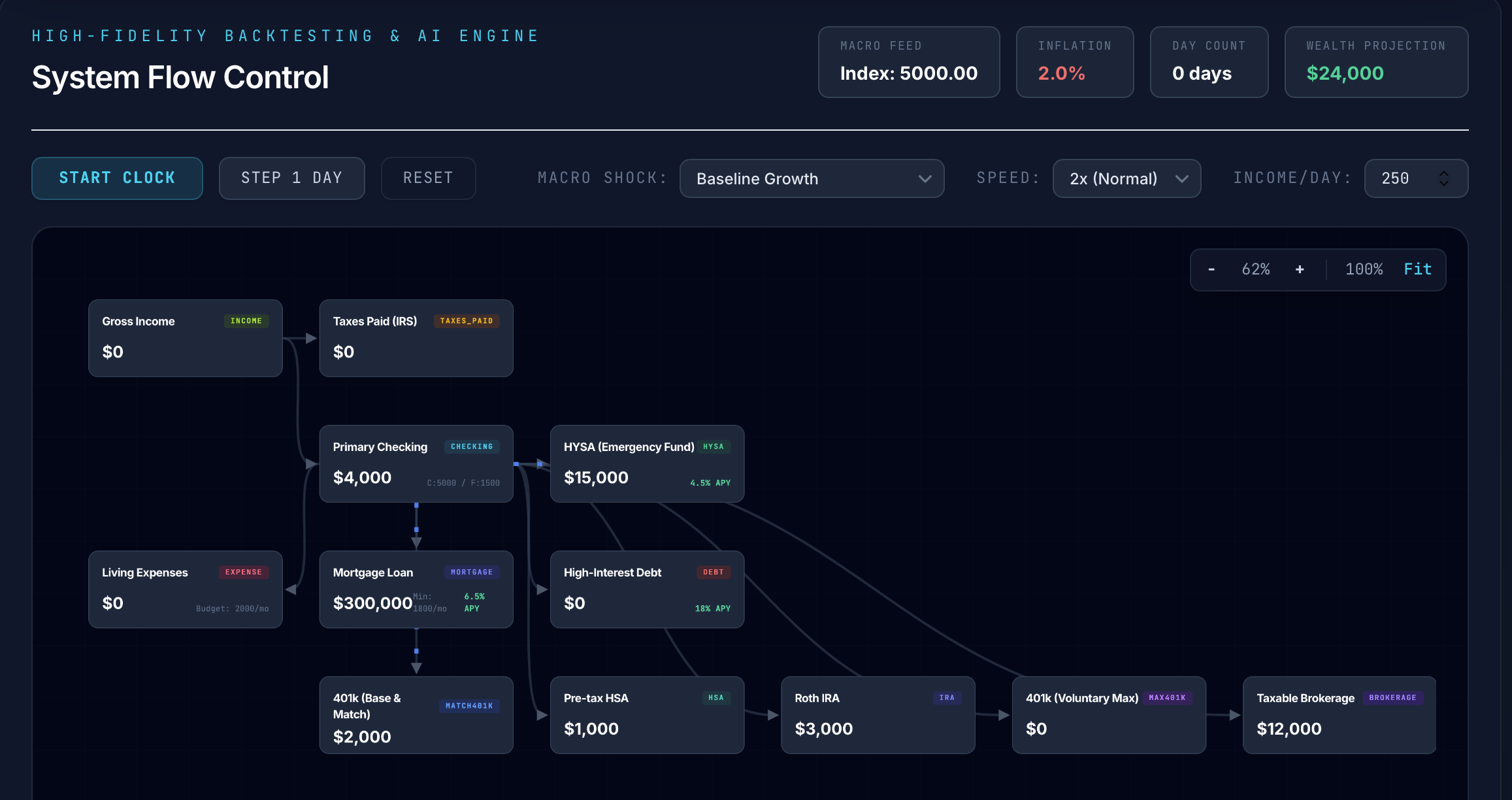
    Infographic: How is the Loh-Friction Philosophy implemented in this program?The Unified Loh-Friction Philosophy i

    Here is how the philosophy is implemented practically across the app’s features and simulation engine:

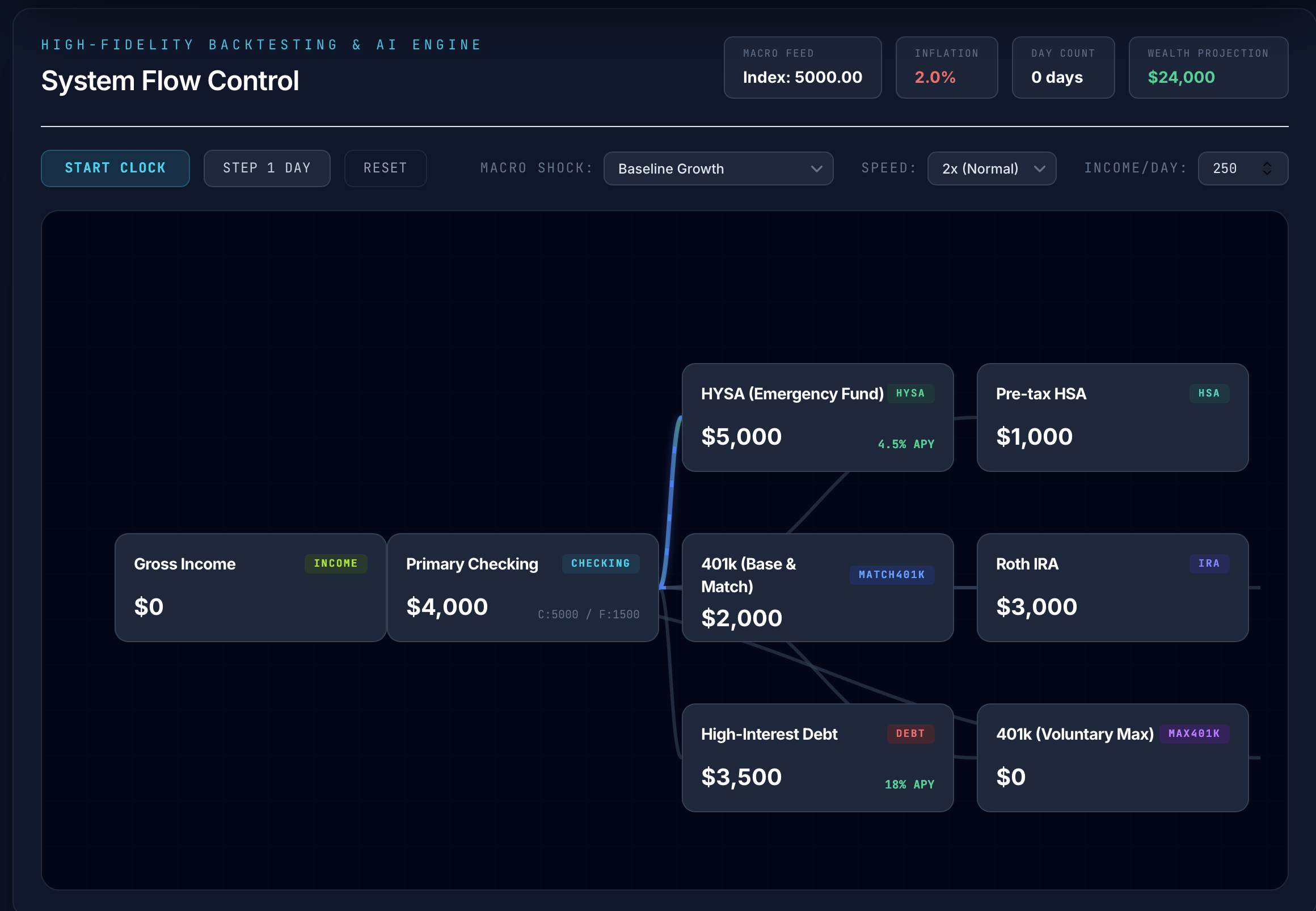
    1. The Dynamic Buffer: Floors and Ceilings

    The simulation engine manages your everyday checking account using two simple, automated triggers:

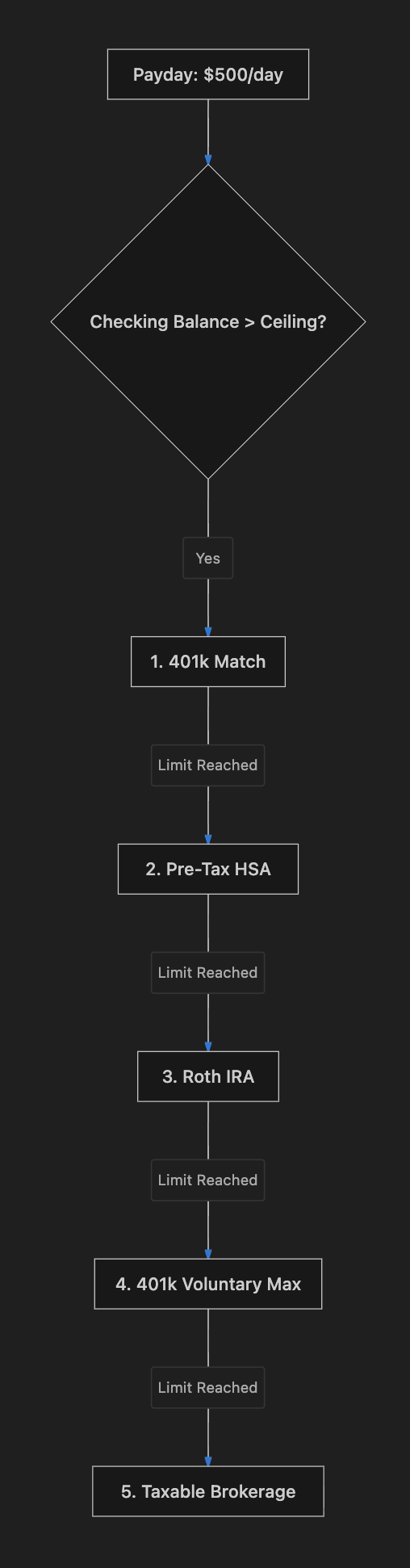
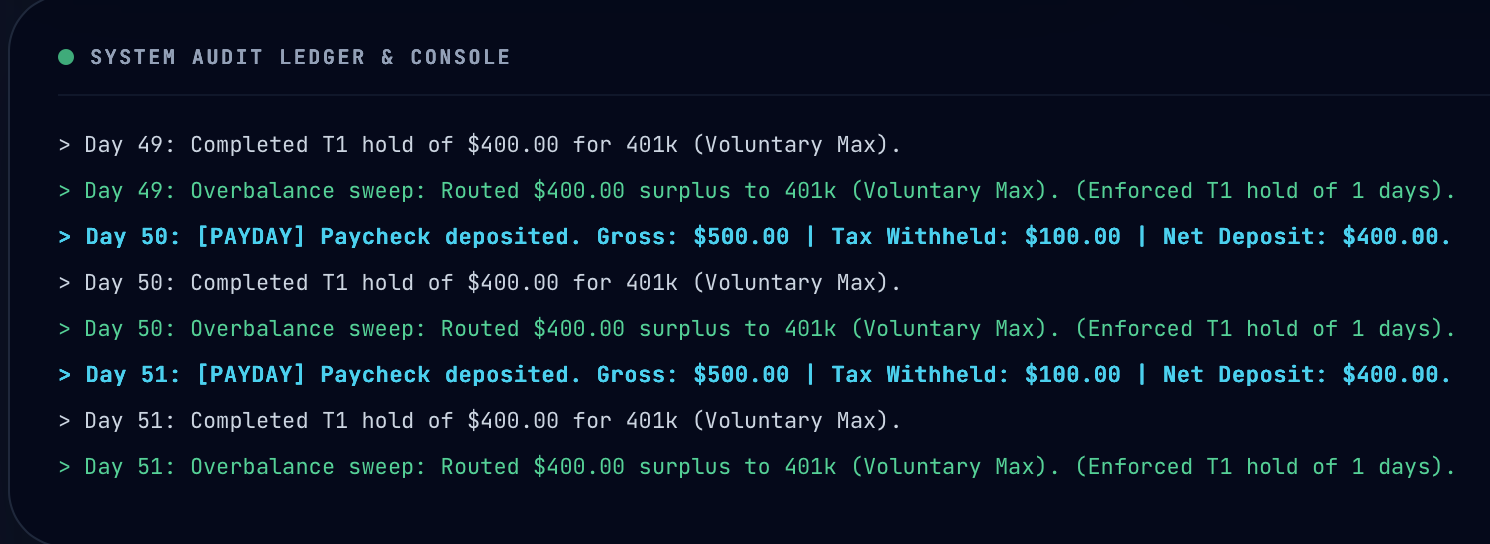
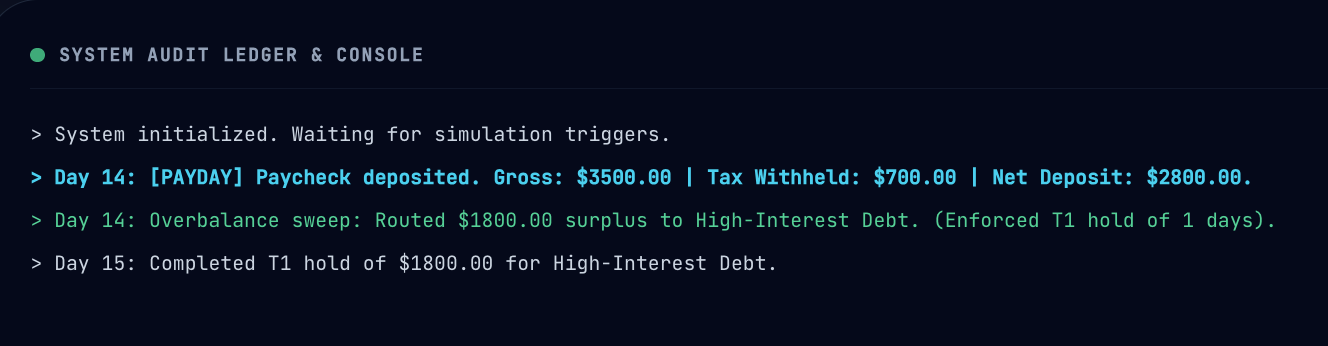
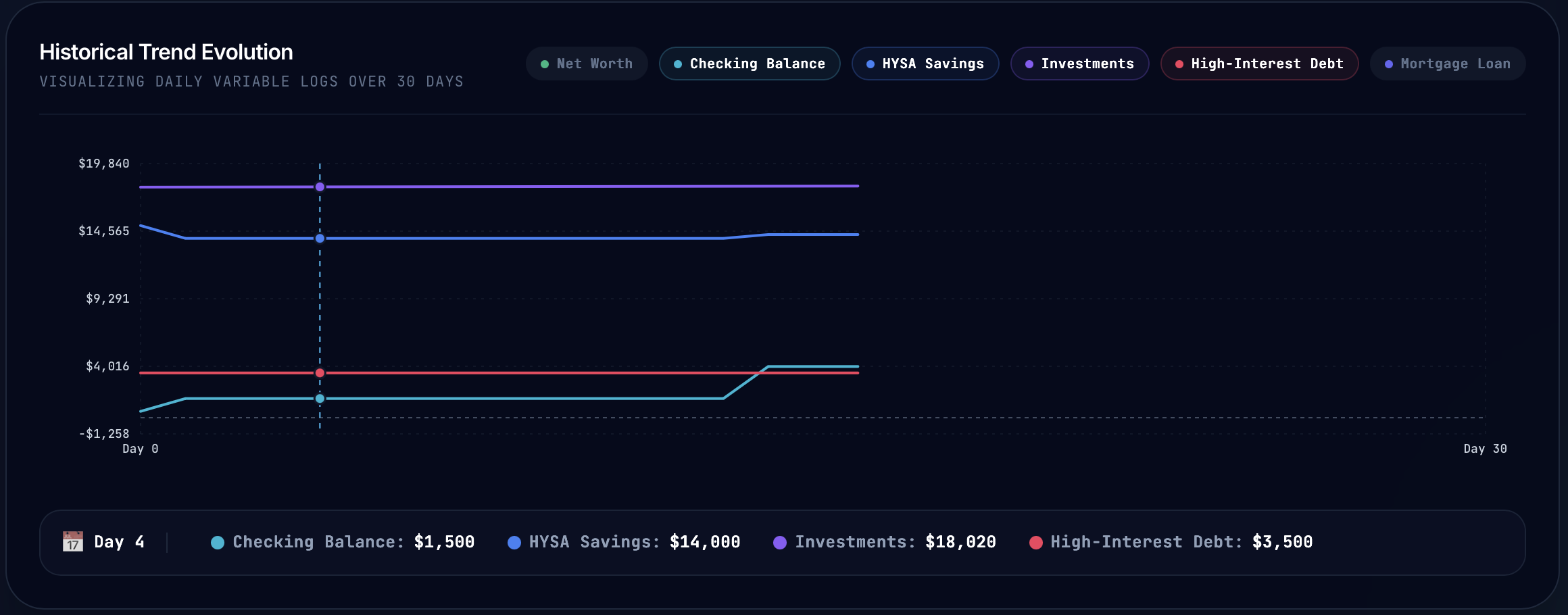
    The Overbalance Sweep (The Ceiling): You set an upper limit for your checking account—say, $3,500. The moment a paycheck drops and pushes you past that limit, the system automatically sweeps the extra money out of checking and routes it into your investments. This stops your money from sitting idle and earning 0% interest.

    Setting thresholds

    The Underbalance Pull (The Floor): You also set a safety floor—say, $1,500. If a big mortgage payment or a string of bills drops your balance below this number, the system instantly pulls cash from your high-yield savings account to top you back up. It completely eliminates overdraft fees and the anxiety of a low balance.

    2. The Financial Waterfall: How Money Moves

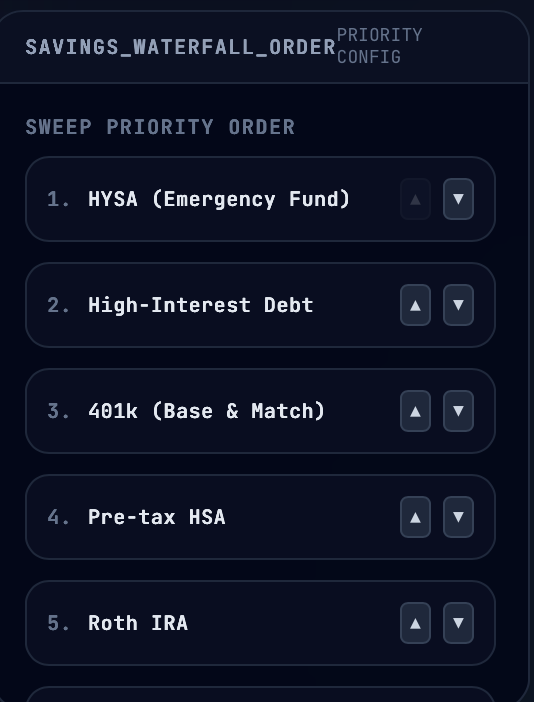
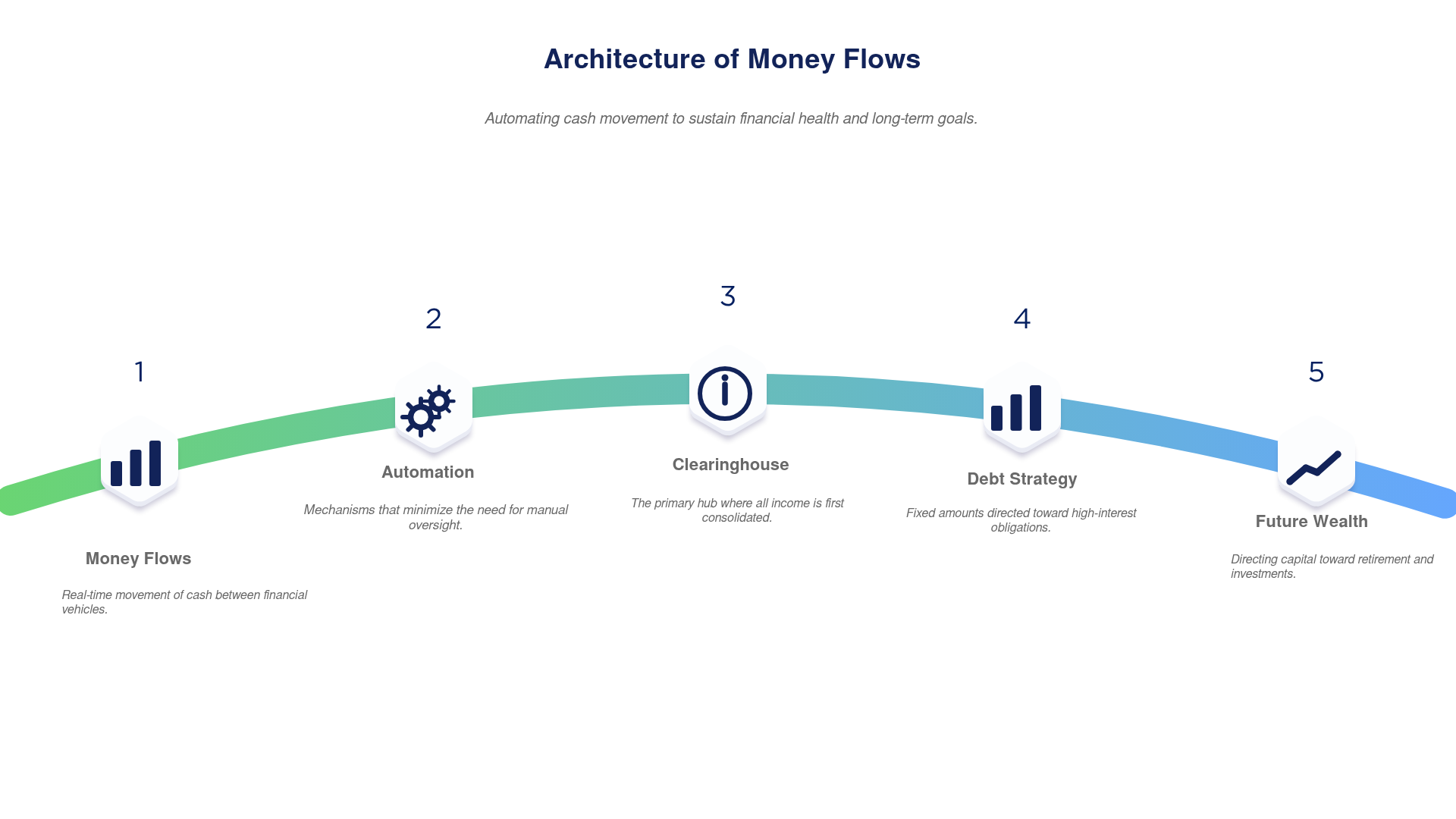
    When you have extra cash, the system routes it step-by-step to make sure every dollar works as hard as possible. You can easily change this order in the UI or command line, but the default sequence follows the smartest financial playbook:

    Free Money First (match401k): It instantly captures your employer’s 401(k) match.

    Kill High-Interest Debt (debt): It aggressively targets and wipes out toxic credit card balances.

    The Safety Net (hysa): It tops off your emergency fund until it hits your target comfort level (like $15,000).

    The Tax-Free Trifecta (hsa): It routes funds into your HSA for pre-tax, tax-free growth, and tax-free spending on healthcare.

    Retirement Maxing (ira / max401k): It fills up your Roth IRA and voluntary workplace contributions.

    The Wealth Compounder (brokerage): Any leftover overflow pours directly into a standard taxable brokerage account.

    3. Real-World Rules and Behavioral Guardrails

    To help you build actual financial discipline, the app mirrors the friction, restrictions, and rules of the real world:

    Locked Retirement Funds: The system locks down retirement accounts like your IRA, blocking you from easily sweeping money back out of them. It trains you to treat retirement money as strictly non-liquid.

    Day Trading Boundaries: If an account has less than $25,000 in equity, the system caps equity sweeps to twice a day, keeping you compliant with real SEC Pattern Day Trader rules.

    Realistic Transfer Latencies: Money doesn’t move instantly in the real world. The app enforces real bank delays—like a 6-day hold for standard ACH transfers into your brokerage, or a 15-day hold for full ACAT account transfers.

    The “Panic Button” Safeguard: During a simulated market crash, the app deliberately pauses everything on Day 18 (right after a 10%+ drop). Before you can touch your portfolio, it forces you to walk through an emotional centering checklist. It’s a brilliant way to practice staying calm instead of panic-selling your assets.

    4. Zero-Friction Setup: The AI Assistant

    To keep you from getting bogged down in menus and settings, the app uses a smart AI console:

    You can just talk to it like a person: type things like “prioritize paying off debt” or “set my checking ceiling to 3500.”

    The system parses your text, converts it into backend logic behind the scenes, and instantly rewires your financial waterfall right on the visual dashboard.

    Screenshot 2026-06-14 at 7.36.40 PM

    I used to feel like my money was always one step ahead of me. Every payday brought the same mental gymnastics: how much to save, what to pay off first, and whether I could afford a treat.

    That friction—that constant tug-of-war—was exhausting. I’ve learned it’s the single biggest thing standing between most of us and a smooth money flow. It’s the invisible weight that makes every financial move feel like a chore.

    Removing the “Kinks” in the Hose

    Friction is anything that slows down or blocks your money from moving where it should go automatically. It’s the hesitation when you’re deciding whether to transfer that extra fifty bucks to savings.

    Think about a garden hose with a bunch of kinks in it. The water is there, but nothing is coming out the other end. That’s what friction does to your financial life. You might have the income, but the “kinks” stop the flow.

    When we talk about reducing friction, we’re talking about smoothing out that path. It’s about making the right choice the easiest choice—or better yet, the only choice that happens automatically.

    Test Your Smart Money Decisions: Real Scenarios

    I’ve been running my own mini financial simulations long before I knew there was a fancy name for it. It all started with a broken washing machine and a maxed-out credit card.

    I remember standing in my laundry room thinking: “If I’d just practiced this moment—like a fire drill—maybe I wouldn’t feel so panicked right now.” That’s the whole point of simulating your money decisions.

    Creating Your Financial Fire Drill

    We have fire drills at school so we know exactly where the exits are when things get smoky. Why do we usually wait for a real-life financial disaster to figure out how we’ll handle one?

    I decided to stop winging it. I started treating my bank account like a game of strategy. I stopped reacting to crises and started predicting them, giving myself an “undo” button for my biggest financial regrets.

    Regulatory Guardrails: How the Simulator Keeps You Compliant

    The Hidden Trap Most Simulators Miss

    Many tools let you dream big without checking the rules. However, real-world money flow is governed by strict limits and tax laws. If your simulation doesn’t account for these, it isn’t a plan—it’s a fantasy.

    Key Regulatory Rules Built Right In

    Regulatory Rule What the Simulator Checks Why It Matters for Your Money Flow
    Roth IRA Contribution Limits Flags over-limit sweeps based on your income and age Prevents a 6% annual penalty that can eat your returns
    Early Withdrawal Penalties Calculates the 10% penalty if you pull funds before 59½ Keeps your simulation realistic—no fantasy early retirement strategies
    401(k) Annual Maximums Caps contributions at $23,000 (or $30,500 if 50+) Avoids the nightmare of overcontributing mid-year
    HSA Contribution Rules Limits your health savings account sweeps by plan type Triple tax benefit only works if you stay under the cap

    This Edge Keeps Your Strategy Real

    You know what I love most about this? It keeps you from making “illegal” moves in your head. By building these guardrails into the flow, you ensure that your automated strategy is actually executable in the real world.

    Real-Time Visualization: See Your Cash Flow Pipelines

    I vividly remember that Sunday-night panic. I’d be sitting at my kitchen table, staring at my phone’s bank app, mentally walking through the next two weeks of bills. It was pure guesswork, honestly.

    That reactive scramble—that “hope and pray” method of banking—is exactly what the Giniloh Money Flow Simulator is designed to kill for good. I want to walk you through why this changed things for me.

    Mapping the Route Ahead

    When we want to get somewhere, we use a map. We don’t just look at our current GPS coordinates and guess where the turns are. We look at the whole route, the traffic, and the construction.

    Why weren’t we doing that with our money? The Giniloh Simulator isn’t a record of where you’ve been; it’s a map of where you’re going. It turns scary numbers into a clear, visual path.

    The End of “Guessing in the Dark”

    Most of us manage our money by looking backward. It’s like trying to navigate a winding mountain road at night without any headlights. You only see the pothole after you’ve already hit it.

    That’s exactly how those annoying overdraft fees happen. You don’t realize you’re short on cash until the bank sends you that “insufficient funds” notification. Visualization changes that dynamic entirely.

    Money Flow

    From Simulation to Action: Taking Control

    I remember the first time I stared at my bank balance and had absolutely no idea what was about to happen next. Payday was three days away, and I was just hoping nothing else hit before Friday.

    By using a simulator, I moved from “hoping” to “knowing.” I could see exactly how a $200 transfer today would affect my balance in three weeks. That clarity is the ultimate antidote to financial anxiety.

    Conclusion: Stop Idling, Start Moving Your Money Forward

    Your Money Flow Deserves a Test Drive

    I remember the first time I tried to get serious about my finances. I sat down with a spreadsheet and about fifteen different “systems” I’d read about online. It was overwhelming and ultimately ineffective.

    Don’t let your financial future be a leap of faith. By simulating your money flow, you can identify the kinks in your hose, avoid regulatory traps, and finally build a system that runs on autopilot.

    FAQ

    What is a money flow simulator and how does it work?

    A money flow simulator is a digital sandbox that allows you to model how cash moves through your accounts in real time. It helps you visualize future balances and test financial decisions without any real-world risk or impact on your actual bank accounts.

    How does proactive money management differ from traditional budgeting?

    Traditional budgeting often looks backward at past spending, whereas proactive management focuses on future pipelines and automated sweeps. This shift allows you to anticipate upcoming expenses and avoid financial obstacles before they occur.

    Does the simulator account for legal contribution limits and tax rules?

    Yes, the tool includes regulatory guardrails for accounts like Roth IRAs, 401(k)s, and HSAs. It flags potential over-contributions or penalties to ensure your simulated strategy is realistic and compliant with current laws.

    How can simulating financial scenarios reduce daily stress?

    By testing outcomes in advance, you remove the need for constant mental math and daily micro-decisions regarding your balance. This reduces decision fatigue and provides clarity on how current spending affects your future financial health.

    What are ‘kinks’ in a money flow, and how are they fixed?

    Kinks are points of friction, such as manual transfers or hesitations, that prevent money from reaching its intended destination efficiently. Identifying these allows you to smooth out the path through automation, making the right financial choice the default action.

    Can I use the simulator for business or enterprise scenarios?

    The Money Flow Simulator is designed to handle both personal and enterprise cash flow scenarios. It provides a scalable way to understand complex money movements and automated sweeps regardless of the account type.


    References

    [1] Interactive correspondent banking flow simulator + comprehensive 5-page cheat sheet covering cross-b.

    [2] Contribute to LiquidityProtocol/AMM-Simulator development by creating an account on GitHub.

    [3] Cash-flow simulator for your life.

    [4] g0v-money-flow has 4 repositories available.

    [5] Transaction Visualization: Generate interactive graphs of your financial transactions, allowing you.

  • Watch Your $500/day Source Income Overflow

    Watch Your $500/day Source Income Overflow

    Key Takeaways

    • By simulating a $500/day income surge from a career promotion, the GiniLoh Money Flow Simulator shows how automated overflow cascades surplus funds through tax-advantaged accounts and into a taxable brokerage, proving that a fully funded emergency reserve and zero debt are the foundation for maximizing wealth acceleration.
    • Imagine your income suddenly surges to $500 a day, your emergency fund is fully stocked at $15,000, and you carry zero high-interest debt. Where does every extra dollar go? The giniloh Money Flow Simulator answers that question with stunning clarity, turning abstract financial planning into a visual, real-time cascade. By simply setting your income and account ceilings—via an AI chat command or a few clicks—you watch surplus cash automatically bypass saturated reserves and flow into tax-advantaged accounts like your 401k, HSA, and Roth IRA. The true power emerges when these hit their annual limits; then, without any manual intervention, every remaining dollar dynamically overflows into a taxable brokerage account. With an audit trail logging each “overbalance sweep,” this simulation transforms a theoretical pay raise into a specific, actionable roadmap for wealth acceleration. It’s not just a chart—it’s a live demonstration of how to make every surge work harder, before you ever see a real paycheck.
    • What if a single promotion could trigger an automatic cash cascade that fills your tax-advantaged accounts to the brim without a single manual transfer?
    See how a promotion to $500/day triggers an automatic cash cascade, filling tax-advantaged accounts without a single manual transfer.

    What if a single promotion could trigger an automatic cash cascade that fills your tax-advantaged accounts to the brim without a single manual transfer?

    💡

    By simulating a $500/day income surge from a career promotion, the GiniLoh Money Flow Simulator shows how automated overflow cascades surplus funds through tax-advantaged accounts and into a taxable brokerage, proving that a fully funded emergency reserve and zero debt are the foundation for maximizing wealth acceleration.

    Short Answer

    In short: By simulating a $500/day income surge from a career promotion, the GiniLoh Money Flow Simulator shows how automated overflow cascades surplus funds through tax-advantaged accounts and into a taxable brokerage, proving that a fully funded emergency reserve and zero debt are the fo

    Commanding the Simulation: Two Paths to Set Your $500/Day Income Surge

    For many, the goal of a $500 and higher daily source income feels like a distant peak, but through these digital laboratories, I’ve learned how to stress-test the strategies that make it a reality.

    Financial simulation software function as digital laboratories, allowing you to stress-test debt-reduction strategies and wealth-accumulation theories before risking real capital. By manipulating variables such as income, spending, and interest rates, you can project your long-term financial health with a level of precision previously reserved for institutional analysts.

    Control Room

    Setting up a scenario focused on debt elimination and emergency fund creation requires a systematic approach to data entry. The primary objective is to transition from a state of high-interest liability to one of capital surplus. This transition is modeled through specific algorithmic executions that simulate the flow of money over months or years providing a clear visual roadmap for the user.

    Comparative Income Projections

    Frequency

    Target Amount

    Annual Equivalent

    Daily

    $500

    $182,500

    Monthly

    $15,208

    $182,500

    Bi-Weekly

    $7,019

    $182,500

    In GiniLoh Money Flow Simulator, you typically choose between two primary methodologies to achieve these goals. Some prefer the integrated AI-driven command console for rapid, high-level configuration. Others opt for the manual adjustment of parameters through a graphical user interface (GUI), seeking more granular control over every dollar. Both methods aim to optimize the balance sheet, though they offer different levels of technical engagement and oversight.

    This tool reflects a broader trend in fintech: the democratization of financial modeling. As these platforms become more accessible, the barrier to entry for complex financial planning continues to fall. This shift allows individuals to act as their own chief financial officers, using data to drive decisions that were once based on intuition or basic spreadsheets.

    The model also requires a fully funded emergency reserve capped at $15,000. This reserve serves as a volatility buffer, ensuring that unforeseen expenses—such as medical bills or urgent home repairs—do not disrupt the long-term investment strategy. Financial analysts frequently cite this state as the “launchpad” for significant wealth building, as it shifts the focus from survival to asset acquisition .

    The importance of this foundation is highlighted by data from the Federal Reserve’s “Report on the Economic Well-Being of U.S. Households.” Recent findings indicate that a significant portion of U.S. households lacks the liquidity to cover a $400 emergency expense using cash or its equivalent. By establishing a $15,000 floor, the individual in this simulation enters the top tier of financial preparedness.

    This baseline allows the “overflow” mechanism to function effectively. Every dollar earned beyond immediate needs and the $15,000 reserve is automatically routed toward wealth-generating vehicles. This structural approach ensures that surplus capital is never left idle, maximizing the time-value of money and the power of compounding interest over decades of a career.

    The simulation emphasizes that the $15,000 cap is not a random figure but a calculated balance between security and opportunity cost. In a high-inflation environment, holding excessive cash can lead to a loss of purchasing power. By capping the reserve, the model forces the “overflow” into assets that historically outpace inflation, such as equities or diversified funds.

    Giniloh Money Flow Simulator Infographic.

    Furthermore, the removal of high-interest debt functions as a guaranteed return on investment. If an individual pays off a credit card with a 20% APR, they are effectively securing a 20% return on that capital. This “risk-free” return is nearly impossible to replicate in the public markets, making debt elimination the most logical first step in any wealth-building cascade.

    Classifying Income Streams for Tax Efficiency

    Effective financial management requires a nuanced understanding of how the Internal Revenue Service (IRS) categorizes different types of revenue. Not all dollars are treated equally under the current tax code, and income classification significantly impacts the net “take-home” value of a professional’s earnings. The simulation identifies three primary categories: earned income, portfolio income, and passive income.

    Earned income, typically reported on a W-2 or 1099 form, is derived from active labor. In the $500-per-day scenario, this income is subject to ordinary income tax rates, which for 2024 range from 10% to 37% depending on the total taxable amount. Additionally, earned income is subject to FICA taxes, comprising 6.2% for Social Security and 1.45% for Medicare .

    For high earners, the marginal tax rate can be a significant drag on wealth accumulation.

    Visualizing the Overflow: How Cash Routes Through Tax-Advantaged Accounts

    Optimizing personal cash flow is a requirement for long-term wealth management, particularly for high-income earners navigating an increasingly complex tax environment. This example analysis using the giniloh Money Flow Simulator modeled a scenario involving a daily income surge of $500. This figure equates to an annual gross income of approximately $182,500, placing the earner well into the upper percentiles of American households.

    The simulation assumes a foundational financial state where the user has already secured a $15,000 emergency fund and eliminated high-interest consumer debt. Once these primary hurdles are cleared, the logic of automated wealth distribution shifts significantly. The focus moves from defensive measures toward tax-advantaged growth and diversified investment vehicles designed for long-term stability.

    In this model, the $500 daily surge is not treated as discretionary spending or lifestyle capital. Instead, it is viewed as raw capital that must be routed through a series of “nodes” designed to minimize tax friction and maximize long-term compound interest. This systematic approach ensures that every dollar is assigned a specific task based on its expected after-tax return and regulatory constraints.

    Money Flow Simulator Canvas

    The giniloh interface visualizes this process as a digital plumbing system, where capital moves through a hierarchy of accounts. When one “bucket” or account reaches its regulatory limit, the flow automatically spills over into the next most efficient vehicle. This removes the decision fatigue that often leads to “lifestyle creep” or uninvested cash sitting in low-interest checking accounts.

    Bypassing the Obvious: The Strategic Shift from Liquidity to Growth

    Traditional financial planning often emphasizes liquidity and debt mitigation above all else, regardless of the earner’s income level. However, the giniloh simulation demonstrates a significant pivot once basic security objectives are met. With a $15,000 emergency fund—representing three to six months of essential expenses for many—the “Money Flow” algorithm bypasses the High-Yield Savings Account (HYSA) and debt-service nodes.

    This transition marks the movement from defensive financial positioning to offensive wealth accumulation. For the $500-per-day earner, the immediate priority identified by the system is the capture of employer-sponsored benefits. This is described by financial analysts as a mathematical imperative in the pursuit of maximum total compensation, rather than a mere suggestion for retirement planning.

    By automating this flow, the simulator removes the psychological friction often associated with manual transfers and market timing. It ensures that no “free money” is left on the table due to administrative oversight or temporary market fluctuations. Financial analysts often refer to this as the “waterfall” method of investing, where capital flows downward through a hierarchy of accounts based on efficiency.

    The logic dictates that every dollar must be assigned a task ranked by its expected after-tax return. In the absence of high-interest debt, the highest immediate return is found in employer matching programs. The giniloh interface highlights these paths, illustrating how capital moves from the gross income node directly into the 401k Match node to secure immediate gains.

    This prioritization is based on the fact that an employer match represents an immediate, guaranteed 50% or 100% return on investment. No other market vehicle can consistently provide such a high, risk-free yield. The simulation treats this as the “Priority 1” destination for all incoming cash flows until the specific match threshold is met for the fiscal year.

    The first destination for surplus cash after building an emergency fund in the simulation is the 401k Match node. This prioritization is based on the immediate, guaranteed return on investment (ROI) provided by employer contributions.

    Furthermore, the simulation highlights the importance of timing. By directing the $500 daily surge toward these matches early in the year, the investor maximizes their “time in the market.” This strategy avoids the pitfalls of trying to time market entries, instead relying on the steady, automated accumulation of assets within the employer-sponsored framework.

    When Limits Are Hit: The Automatic Overflow Into Taxable Brokerage

    The Overflow Cascade in Action

    For high-income earners, the transition from basic saving to aggressive wealth building typically begins at a specific mathematical milestone. Financial planners often refer to this as the “surplus threshold.” It marks the point where an individual’s primary obligations—including mortgages, daily living expenses, and emergency reserves—are fully funded, leaving a significant portion of monthly income available for strategic investment.

    In this example, an individual earning a daily income of $500. This equates to an annual gross salary of approximately $182,500. At this level, managing the surplus requires a systematic approach to maximize tax efficiency and long-term growth. In this scenario, a $15,000 emergency fund serves as a necessary liquid buffer for this individual, while debt balances are ideally kept at zero to prevent interest rates from eroding the portfolio’s compounding potential.

    2025 Tax-Advantaged Contribution Limits

    Account Type

    Individual Limit

    Family Limit

    HSA (Health Savings Account)

    $4,300

    $8,550

    401(k) Employee Contribution

    $23,500

    N/A

    Roth/Traditional IRA

    $7,000

    N/A

    To track these capital movements, many modern investors can utilize tools like the giniloh Money Flow Simulator. This digital platform models capital distribution across various account types, illustrating how money moves through a complex financial ecosystem. When the simulation speed is increased, a distinct pattern known as the “overflow cascade” emerges. This represents a hierarchical logic for saving that prioritizes the most tax-efficient accounts first.

    The cascade functions as a series of connected vessels. As one account reaches its regulatory limit, the remaining capital automatically redirects to the next available vehicle. In a high-income model, the simulator shows cash bypassing high-yield savings accounts and debt-repayment nodes—which are already saturated—and flowing directly into tax-advantaged retirement accounts.

    The first tier of this cascade involves pre-tax contributions, specifically employer-sponsored 401(k) matches and Health Savings Accounts (HSAs). Economists generally view the 401(k) match as a guaranteed return on investment. It represents an immediate 100% gain on contributed funds up to the employer’s limit, making it the most logical starting point for any financial surplus.

    Waterfall

    Once the employer match is secured, the flow typically moves toward the HSA. This account is highly prized by tax strategists for its “triple tax advantage.” Contributions reduce taxable income, the balance grows tax-free, and withdrawals for qualified medical expenses are also exempt from taxation. For the 2025 tax year, the IRS has increased these limits to account for persistent inflationary pressures.

    The individual HSA contribution limit for 2025 is set at $4,300, while the family limit has risen to $8,550. For the $500-a-day earner, filling this bucket is a priority because it serves as both a health fund and a “stealth” retirement account. If funds are not immediately required for medical costs, they can be invested in the market for long-term growth, effectively functioning as a secondary IRA.

    After the HSA is maximized, the simulation directs the surplus toward the Roth IRA. This account offers the benefit of tax-free growth and tax-free withdrawals in retirement.

    Mastering the Wealth Cascade: How to Autopilot this Big Promotion

    In this example, your income has surged to $500 a day (roughly $15,000 a month), your credit cards are completely paid off, and you’re sitting on a comfortable $15,000 cash cushion in a high-yield savings account.

    What do you actually do with all this extra cash?

    If you leave it sitting in your checking account, it’s going to do one of two things: earn absolutely zero interest, or slowly vanish because of “lifestyle creep.” In this exercise with the Simulator, we look at exactly how to put your new income on autopilot—creating a financial waterfall that automatically channels your wealth into the right investments.

    The Big Idea: The Financial Waterfall

    Think of your personal finances as a series of connected buckets. When your paycheck hits, your primary checking account fills up first. Once it reaches a comfortable baseline, any extra money automatically “overflows” into the next bucket down the line.

    Since you’ve already wiped out your high-interest debt and built a rock-solid emergency fund, the simulator bypasses those basic safety nets entirely. Instead, it instantly routes your surplus cash straight into your wealth-building goals, following a strict Financial Order of Operations.

    The Waterfall

    1. Bucket 1: The Employer 401(k) Match – The system first secures “free money” by capturing your full employer match.

    2. Bucket 2: The Health Savings Account (HSA) – Surplus funds then route to your HSA to maximize triple-tax-advantaged savings.

    3. Bucket 3: The Roth IRA – The cascade then fills your Roth IRA for tax-free growth.

    4. Bucket 4: Maxing the 401(k) – Extra cash is routed to max out the remainder of your workplace 401(k).

    5. Bucket 5: The Taxable Brokerage – The ultimate overflow bucket for any remaining capital

    The Magic of Dynamic Overflow

    What happens when an account hits its annual contribution cap? (For example, a Roth IRA has a strict limit of $7,000 per year).

    In the simulator, you can watch this happen in real time. The moment the Roth IRA node hits its $7,000 contribution ceiling, the glowing path on the canvas shifts dynamically. It closes the route to the Roth IRA and instantly opens the pipeline to the next bucket downstream—your Taxable Brokerage account. Your money never sits idle; it redirects itself to the next best target.

    The Automated Configuration: AI Chat Console Integration

    By utilizing natural language processing (NLP) in the console, you can bypass menu navigation and technical commands. This allows for the implementation of complex financial directives through simple, text-based commands that the system interprets and applies across all modules.

    This automated approach is often the first choice for those seeking efficiency.

    * Method A: AI Chat Console

    Type the following command in the chat bar and hit Send:

    “Set my income to 500 a day. Set my HYSA balance to 15000 and its ceiling to 15000. Set my debt to 0”. Set waterfall priority in the following order: match401k (401k Match), hsa (Pre-tax HSA), ira (Roth IRA), * max401k (401k Voluntary Max), brokerage (Taxable Brokerage), hysa (HYSA), debt (High-Interest Debt)”

    * Method B: Manual UI Configuration

    1. Adjust the Income/day box in the top control bar to 500.

    2. Click the HYSA (Emergency Fund) node. Set Balance to $15,000 and Ceiling to $15,000.

    3. Click the High-Interest Debt node. Set Balance to $0.

    4. Go to the Savings Waterfall Order panel at the bottom right and configure the following priority order:

    * match401k (401k Match)

    * hsa (Pre-tax HSA)

    * ira (Roth IRA)

    * max401k (401k Voluntary Max)

    * brokerage (Taxable Brokerage)

    * hysa (HYSA)

    * debt (High-Interest Debt)

    The Historical Trend

    This chart is the “holy grail” of automated wealth building. It proves that by setting a simple dual-threshold rule (a floor to protect you from overdrafts and a ceiling to prevent idle cash drag), your money automatically optimizes itself. It pays your bills, maintains your emergency fund, and aggressively sweeps every single extra dollar directly into compounding investment accounts.

    1. The Automated Investment Climb (The Rising Purple Line)

    Because the checking account is capped at $5,000, any net daily income above this ceiling is a surplus. The engine checks the Financial Order of Operations (FOO) waterfall:

    • The High-Interest Debt node is already at $0 (no capacity).

    • The HYSA is already at its $15,000 ceiling (no capacity).

    • Consequently, the surplus cash automatically cascades into the downstream investment vehicles (401k Match, HSA, Roth IRA, and Taxable Brokerage).

    • This causes the Investments line (purple) to climb steadily from Day 0 to Day 29 as daily sweeps funnel money directly into the market.

    2. The Monthly Expense Dips (Day 30 and Day 60)

    On Day 30 and Day 60, the checking account experiences a sharp drop:

    • The system automatically debits fixed monthly costs (the mortgage payment and living expenses) directly from Checking.

    • This drops the checking balance below its $5,000 ceiling.

    • The Rebuilding Phase: For the next 5 days (Day 30 to 35, and Day 60 to 65), the Investments line goes flat. This is because the engine dynamically halts outbound sweeps, allowing the daily incoming cash to stay in Checking and rebuild the primary cash buffer.

    • Once the checking balance recovers and touches the $5,000 ceiling again (on Day 35 and Day 65), the waterfall sweeps instantly reactivate, and the purple line resumes its upward climb.

    3. The Untouched Safety Net (The Flat Blue Line)

    Throughout the entire 86-day simulation, the HYSA Savings line (blue) remains flat at $15,000 (gaining only minor monthly interest yield). Because the primary checking cash buffer is designed to absorb both daily income and monthly expenses, the emergency fund is never forced to liquidate or cover standard bills. It remains completely insulated as a true worst-case safety net.

    Adding “Smart Brains” with Scripting Rules

    To make this automation truly responsive, you can integrate three automated rules that react to your life and the stock market:

    • Rule 1: The Lifestyle Booster

      • The Rule: IF debt == 0 THEN set checking ceiling 3,500

      • How it works: Once your toxic high-interest debt is gone (which is already in this example) , the system automatically raises your Checking ceiling to $3,500. This lets you keep a little more liquid cash on hand to enjoy your new promotion guilt-free, while still sweeping the rest to investments.

    • Rule 2: The Emergency Overflow

      • The Rule: IF hysa >= 10,000 THEN prioritize investments

      • How it works: If your emergency fund is fully capitalized, the system automatically flips your waterfall priority to wealth building, routing all new cash directly into retirement and brokerage accounts rather than piling up unnecessary cash.

    • Rule 3: The “Buy the Dip” Trigger

      • The Rule: IF sp500 < 4300 THEN checking brokerage

      • How it works: If you trigger a market crash in the simulator, the system acts like an algorithmic investor. The moment the S&P 500 falls below 4,300, it bypasses standard waterfall limits and sweeps an extra $1,200 directly from your checking account into stocks to buy them at a discount. This simulated environment, the baseline scenario involves a professional earning a daily income of $500, which totals approximately $15,000 per month. This income level places the individual in a high-earning bracket where tax efficiency and automated allocation become critical for long-term success. The simulation assumes a “debt-free” status, specifically the absence of consumer debt like credit card balances or high-interest personal loans.

    Reading the Audit Trail: Real-Time Logs of Your Surplus Routing

    A substantial rise in household earnings, such as a promotion resulting in a daily rate of $500, offers a rare window for rapid wealth acceleration. While high liquidity is a clear advantage, the ultimate success of that capital depends on how it is deployed across various financial vehicles. In the landscape of modern financial planning, the giniloh Money Flow Simulator serves as a high-speed environment for modeling these critical transitions.

    You can adjust variables manually to test different economic conditions, but the system’s core utility is found when the simulation clock begins. Once active, the underlying logic dictates the movement of capital. This approach moves away from the static nature of traditional budgeting, which often fails to account for the daily velocity of cash.

    The audit Ledger

    Instead of looking at a snapshot of a bank account in the canvas, you can watch a dynamic process unfold in the Audit Trail and Historical Trends. The simulator treats money as a flow rather than a fixed pool, reflecting the reality of daily earnings and recurring obligations in a high-income household.

    By simulating a $500 daily income—which equates to roughly $182,500 annually—you can see how quickly your various financial “buckets” fill. This visual feedback is essential for understanding the velocity of money and the impact of compounding.

    The system’s ability to compress time allows you to see the results of your decisions years in advance. This temporal compression helps bridge the gap between daily habits and long-term outcomes. By observing the flow over a simulated decade, you can identify potential shortfalls or opportunities for optimization that would otherwise remain hidden.

    The Audit Trail: A Narrative of Capital Allocation

    When the simulation runs at an accelerated rate, such as 5x speed, the interface tracks the movement of funds across a digital map. In a scenario where the High-Yield Savings Account (HYSA) is already at its $15,000 ceiling and no debt exists, the system automatically bypasses those nodes. The logic directs surplus income to the next priority: the

    • Establishing a $15,000 emergency reserve and eliminating all high-interest debt serves as the essential foundation for transitioning from reactive spending to proactive wealth accumulation.

    • Utilizing an automated ‘overflow’ system allows surplus income to bypass saturated savings accounts and flow directly into high-priority investment vehicles, reducing decision fatigue and preventing lifestyle creep.

    • Strategic capital allocation should prioritize the ‘waterfall’ method, first securing guaranteed returns through employer 401(k) matches before maximizing tax-advantaged options like Health Savings Accounts.

    • Once annual contribution limits for tax-advantaged accounts are met, directing the remaining income surge into a taxable brokerage account ensures that capital remains productive and continues to compound over time.

    FAQ

    What is the significance of the $500 daily income target in this simulation?

    A $500 daily income equates to approximately $182,500 annually, serving as a catalyst for aggressive wealth building. This level of liquidity allows the simulation to demonstrate how surplus funds can be systematically routed once foundational needs are met.

    Why does the model prioritize debt elimination over immediate savings?

    High-interest debt acts as a structural drag on net worth, often carrying interest rates that exceed market returns. Paying off these liabilities provides a guaranteed, risk-free return on capital, creating a stable foundation for future investments.

    What is the purpose of capping the emergency fund at $15,000?

    The $15,000 cap provides a sufficient volatility buffer for most households while preventing excessive cash from losing purchasing power to inflation. Once this ceiling is reached, the overflow mechanism directs additional capital into assets with higher growth potential.

    How does the overflow cascade determine where capital is allocated?

    The cascade follows a hierarchy of tax efficiency, starting with employer-sponsored 401(k) matches to secure guaranteed returns. It then fills other tax-advantaged vehicles like HSAs and Roth IRAs before finally directing remaining funds into taxable brokerage accounts.

    Why is the Health Savings Account (HSA) considered a high-priority investment vehicle?

    The HSA offers a triple tax advantage: contributions reduce taxable income, growth is tax-free, and withdrawals for medical expenses are exempt from tax. If funds are not needed for immediate healthcare, they can be invested for long-term growth, functioning similarly to a secondary IRA.

    What happens to surplus income once all tax-advantaged contribution limits are reached?

    Once regulatory limits for accounts like the 401(k), HSA, and Roth IRA are met, the simulation routes the remaining surplus into a taxable brokerage account. This ensures that every dollar continues to work toward wealth accumulation rather than sitting idle in a low-interest checking account.

    How does the simulation help in managing lifestyle creep?

    By automating the distribution of every dollar toward specific financial goals, the system removes the decision fatigue that often leads to increased discretionary spending. This structural approach ensures that income surges are converted into lasting assets rather than temporary lifestyle upgrades.


  • How to Simulate Emergency Expense Protection

    How to Simulate Emergency Expense Protection

    Key Takeaways

    • Transition from static savings targets to dynamic liquidity models to ensure your emergency fund remains effective against inflation and fluctuating cost-of-living demands.
    • Implement automated floor protection to maintain a minimum balance in your primary accounts, which prevents the accumulation of high-interest debt by instantly restoring funds when they drop below a set threshold.
    • Use simulation tools to visualize the movement of your capital, allowing you to stress-test your financial resilience and verify that your automation rules function correctly before a crisis occurs.
    • Balance aggressive debt repayment with the simultaneous growth of a liquid buffer to avoid the cycle of borrowing that often occurs when unexpected expenses strike during a debt-paydown phase.
    Discover how the Giniloh Simulator’s automated floor sweeps protect your emergency expense account in real time.

    What if your emergency fund could automatically refill itself the moment an unexpected bill drained your checking account—no manual intervention required?

    💡

    By simulating an emergency expense scenario in Giniloh’s frictionless money flow simulator, users can automate floor protection to instantly restore their checking account from $500 to $1,500, proving that proactive system design prevents financial shocks and eliminates the need for high-interest debt.

    Short Answer

    In short: By simulating an emergency expense scenario in Giniloh’s frictionless money flow simulator, users can automate floor protection to instantly restore their checking account from $500 to $1,500, proving that proactive system design prevents financial shocks and eliminates the need

    Practice Your Emergency Expense Response Before It Happens with giniloh simulator.

    I have learned through years of financial observation that unplanned financial obligations often strike during periods of economic instability, creating immediate threats to household security. In my own life, I’ve seen how sudden car repairs or failing home appliances are more than simple nuisances; they represent significant financial shocks. I believe these events can dismantle even the most disciplined long-term savings plan if a family lacks a dedicated buffer.

    Economic analysts view these disruptions as the primary catalyst for the accumulation of long-term debt. Without liquid cash available, households often turn to high-interest borrowing to cover basic needs. This shift from a savings-based model to a debt-reliant one marks the beginning of a difficult cycle that can take years to reverse.

    Financial emergencies rarely occur in isolation and often coincide with broader market downturns or personal professional setbacks. This convergence of risks needs a more robust approach to liquidity than many traditional models suggest.

    In this article we will model impact of these shocks in the Money Flow Simulator to better understand how this process works and specially the scenario with Debt Paydown & Savings.

    Build your emnergency response fund

    Defining the Scope of Emergency Expenses

    An emergency expense is defined by financial experts as any unanticipated cost that disrupts daily cash flow or threatens long-term solvency. Financial planners stress that a dedicated cash reserve is the most effective tool for mitigating these risks. This approach is preferred over relying on credit cards or short-term loans, which carry significant long-term costs.

    The Defensive Barrier Against Debt

    The goal of an emergency fund is to build a defensive barrier against high-interest debt. By separating these funds from daily spending accounts, consumers can protect their financial goals from external pressures. This isolation ensures that a broken water heater does not result in a decade of interest payments or the liquidation of retirement assets.

    A functional reserve provides more than just a safety net; it offers a predictable path through unpredictable events. When a household can pay for a repair in cash, they avoid the 22.8% interest rates common in the current credit market.

    Preserving Capital and Wealth

    This preservation of capital allows for continued investment in other areas, such as retirement or education, maintaining the trajectory of wealth building. Furthermore, the definition of an emergency has evolved in the modern economy. While traditional views focused on catastrophic failures, modern financial planning includes “maintenance shocks”—costs that are inevitable but irregular.

    Infographic: An emergency expense

    Expense Type

    Traditional Classification

    Modern Financial View

    Major Medical Bill

    Catastrophic Emergency

    Systemic Liquidity Risk

    Car Transmission Failure

    Unforeseen Accident

    Predictable Maintenance Shock

    HVAC Replacement

    Home Disaster

    Amortized Asset Depreciation

    Statistical Analysis of Financial Vulnerability

    Recent economic data highlights a widespread lack of resilience among U.S. households. Research shows that nearly half of the population would struggle to cover a $500 emergency expense using only cash or savings. This vulnerability forces many to liquidate assets or take on new debt at unfavorable terms.

    When faced with these costs, a large segment of the population relies on credit cards as their primary fallback. With median interest rates currently hovering at 22.8%, this reliance creates a high-cost temporary fix. While the immediate problem is solved, the resulting interest payments often lead to greater instability over time.

    The Narrow Margin for Error

    Approximately 30% of Americans report ongoing difficulties with debt management. For these individuals, a single financial disruption can trigger a prolonged economic recovery period. The data suggests that the margin for error in the modern economy has narrowed significantly for the average earner.

    This widespread fragility is not limited to low-income brackets. Even middle-class households often find their liquid reserves depleted by rising housing and healthcare costs. The inability to access $500 in a crisis is a leading indicator of potential future insolvency.

    What Is an Emergency Expense and Why You Need More Than a Static Goal

    The Evolution of Emergency Expense Management

    In the modern financial landscape, the traditional definition of an “emergency expense” is undergoing a significant transformation. While conventional wisdom once categorized these events as isolated physical failures, market analysts are increasingly defining them through the lens of cash flow disruption.

    An emergency expense is now more accurately described as any unanticipated financial obligation that compromises a household’s immediate liquidity. This shift reflects a move toward a more comprehensive understanding of personal solvency. It moves the focus away from the event itself and toward the impact on the monthly budget.

    The Limitations of Static Targets

    Historically, financial advisors have recommended static milestones for emergency savings, such as a $1,000 “starter fund.” These benchmarks provide a foundational objective for many families. However, critics argue they lack the flexibility required to navigate a volatile economic landscape where costs can shift rapidly.

    Static goals are inherently vulnerable to external pressures, most notably inflation. A $1,000 fund established five years ago does not cover the same emergency today. Furthermore, a single month of significant financial hardship can deplete a fund that required months of disciplined saving to establish.

    Table 2: Static vs. Dynamic Emergency Planning

    Feature

    Static Savings Model

    Dynamic Liquidity Model

    Target Amount

    Fixed (e.g., $1,000)

    Variable based on monthly burn

    Inflation Adjustment

    Manual / Infrequent

    Automated / Real-time

    Risk Management

    Reactive

    Proactive (Ceilings and Floors)

    Moving Toward Dynamic Liquidity

    This vulnerability leaves the household exposed to subsequent shocks. If a second emergency occurs before the first fund is replenished, the family often falls into a debt cycle. The traditional model assumes a linear recovery that rarely matches the chaotic reality of modern life.

    liquidity

    Financial technologists now suggest that the “three-to-six-month” rule should be viewed as a baseline rather than a ceiling. In an era of gig work and fluctuating income, the ability to access cash quickly is often more important than the total amount saved. This realization has sparked a new interest in automated cash management tools.

    The Statistical Landscape of Household Savings Shortfalls

    The urgency of redefining emergency preparedness is underscored by recent data regarding the state of American household finances. Research conducted by Ramsey Solutions indicates a profound lack of financial resilience across a broad demographic spectrum. These findings suggest that many families are living on the edge of a total financial collapse.

    According to their findings, 48% of Americans report an inability to cover their standard living expenses for a period of 90 days in the event of a total income loss. This lack of a buffer makes the management of a sudden emergency expense nearly impossible without external assistance.

    Introducing the Giniloh Simulator: Your Hands-On Lab for Emergency Planning

    The Simulation Environment: A Laboratory for Financial Modeling

    The Giniloh Frictionless Money Flow Simulator functions as a modeling environment. It is designed to allow users to observe the long-term outcomes of financial behaviors within a controlled, risk-free setting. Unlike traditional static spreadsheets, this platform utilizes a dynamic visual canvas.

    This canvas serves as the primary interface where financial entities are represented as interactive nodes. These nodes range from liquid assets like checking accounts to long-term liabilities such as credit card debt. They are interconnected by logical pathways that dictate how capital migrates through a user’s financial ecosystem.

    Visualizing the Velocity of Money

    The system is engineered to function as a high-fidelity environment for personal finance. By transforming abstract numbers into a tangible flow, the simulator helps users visualize the “velocity of money” within their own private economies. This is essential for understanding how an emergency expense impacts the whole system.

    The architecture of the simulator is built on the principle that financial health is not just about the total balance, but the efficiency of movement. In many traditional banking systems, money remains stagnant or moves through “high-friction” processes. The Giniloh environment seeks to model a “frictionless” alternative.

    The User Interface and AI Integration

    Accessing the simulator reveals a structured and modular user interface designed for both clarity and depth. The central canvas provides a macro view of the user’s financial structure. This bird’s-eye view is essential for understanding the interconnectedness of different financial goals.

    To the left of this central display is the AI Chat Console, a natural language processing interface. This feature allows users to configure complex financial parameters through plain-English commands. The system then translates these descriptions into the underlying logic that drives the simulation.

    Scenario 1: Automated Debt Paydown While Building Your Emergency Fund

    Strategic Integration of Debt Reduction and Emergency Fund Development

    The struggle to balance aggressive debt repayment with the need for emergency savings has become a defining conflict. For many families, the attempt to save while carrying high-interest debt feels like trying to fill a reservoir with a structural leak. Every dollar directed toward savings is viewed as a missed opportunity to reduce debt.

    However, financial advisors warn that ignoring savings entirely creates a different kind of risk. Directing every available cent toward debt leaves a household vulnerable to sudden, unavoidable financial shocks. Without liquid reserves, a $1,200 emergency car repair can force an individual back into the cycle of borrowing.

    The Psychological vs. Mathematical Debate

    This cycle frequently creates a “revolving door” of debt. Financial theorists have long debated which priority should take precedence: mathematical efficiency or psychological security. The sequence of these payments determines the long-term sustainability of the financial plan.

    Prominent financial advisor Dave Ramsey famously argues for a “starter” emergency fund of $1,000 before tackling any non-mortgage debt. This approach prioritizes psychological momentum. By providing a small buffer, the strategy prevents new debt from accumulating during the repayment process.

    Method

    Primary Focus

    Emergency Buffer

    Debt Snowball

    Psychological Wins

    $1,000 Starter Fund

    Debt Avalanche

    Interest Minimization

    Minimal / Delayed

    Automated Hybrid

    Algorithmic Efficiency

    Dynamic Floor Protection

    Algorithmic Allocation in High-Inflation Environments

    Modern financial technology now offers a middle ground through automated hybrid systems. These platforms use algorithmic allocation to balance emotional security with mathematical efficiency. By executing both strategies simultaneously, these systems provide safety without ignoring compounding debt costs.

    Industry analysts note that these automated systems are particularly effective in a high-inflation environment. When the cost of living rises, the “disposable surplus” in a household budget shrinks. Algorithmic management ensures that even small amounts of capital are deployed where they have the greatest impact.

    Step-by-Step:

    Objective A user takes home $2,800 every two weeks ($200/day). They currently have $3,000 in checking but want to cap it at $2,000 to prevent lifestyle inflation. They carry $4,000 in high-interest credit card debt and want to watch the system automatically deploy the surplus to wipe out the debt.

    Choose one of the following methods to configure the scenario, then trigger the execution.

    Method A: AI Chat Console

    Type the following command into the chat bar and press Send:

    Plaintext

    Set my paycheck to 3500 every bi-weekly. Set my checking balance to 3000 and limit it to 4000 (ceiling) with 1500 as the floor. Set my debt to 4000. Prioritize paying high interest debt first and then build my emergency fund.
    

    The AI orchestration chat

    Method B: Manual UI Configuration

    1. Click the Primary Checking node on the canvas. In the parameter drawer, set Balance to $3,000 and Ceiling to $2,000.

    2. Click the High-Interest Debt node. Set the Balance to $4,000 and confirm the APY is set to 18.0%.

    3. Go to the Savings Waterfall Order panel at the bottom right and ensure High-Interest Debt is prioritized at the top.

    Execution Trigger Select 2x (Normal) speed and click Start clock (or use Step 1 day to advance manually).

    Expected Observations

    • Canvas Visualization: A glowing cyan flow path connects the Primary Checking node to the High-Interest Debtnode. Because checking is $1,000 over its ceiling, this surplus immediately sweeps down the path.

      Simulator Canvas Setup

    • Debt Elimination: Watch the debt node balance decrease daily until it hits exactly $0, resolving the liability automatically and from then on, the High yield savings account increase with some transients at the end of the month if there are no sufficient funds to pay living expenses and mortgage.

    Simulated historical trends

    Audit Trail Log: Look at the console on the bottom right to verify the following postings:

    Day 1: Overbalance sweep: Routed $1000.00 surplus to High-Interest Debt. Day 30: Debt charged $X.XX interest. (Repeats every 30 simulated days)

    System Audit Ledger

    Scenario 2: Emergency Expense Floor Protection in Action

    Step-by-Step: Simulating an Emergency Expense Floor

    Modern financial management is shifting from reactive budgeting to automated risk control. At the center of this evolution is the “liquidity floor,” a strategy that sets a minimum balance in a primary transaction account. This approach aims to prevent the accumulation of high-interest debt by maintaining cash at all times.

    By simulating a scenario with a $500 starting balance and a $1,500 protection floor, users can observe how automation maintains solvency. This process moves beyond tracking past spending to focus on securing future cash flow. The simulation illustrates the restorative capabilities of this approach.

    The Strategic Framework: Defining the Restoration Floor

    In this financial model, the floor is a functional trigger for restoration rather than just a static target. While traditional budgets focus heavily on categorizing past expenditures, this system prioritizes future liquidity. The simulation tests institutional resilience using a $500 balance and a $1,500 protection target.

    Setting a floor higher than the current balance is a deliberate stress test. It forces the financial system to build liquidity aggressively rather than simply protecting existing capital. Financial experts often suggest a $1,000 to $2,000 buffer to manage emergencies without relying on credit cards .

    Objective A user has a healthy $15,000 emergency reserve in their High-Yield Savings Account (HYSA) and wants to enforce a checking account safety floor of $1,500. When an unexpected expense drops their checking balance to $500, this scenario verifies that the floor restoration sweeps execute correctly.

    Choose one of the following methods to configure the scenario, then trigger the execution.

    Method A: AI Chat Console

    Type the following command into the chat bar and press Send:

    Plaintext

    Set my paycheck to 3500 every bi-weekly. Set my checking balance to 500 and limit it to 4000 (ceiling) with 1500 as the floor. Set my HYSA to 15,000.
    

    Method B: Manual UI Configuration

    1. Click the Primary Checking node on the canvas. Set Floor to $1,500 and Balance to $500.

    2. Click the HYSA (Emergency Fund) node. Set Balance to $15,000.

    Execution Trigger Click the Step 1 day button once.

    Seeing Your Money Move: Real-Time Visualization and Audit Trails

    The primary objective of this visualization is to offer a real-time audit of automated financial rules. This ensures that the programmed logic is executing exactly according to user-defined parameters. The canvas serves as a functional blueprint, making complex strategies visible and verifiable.

    • Canvas Visualization: The canvas draws a reverse sweep path from the HYSA (Emergency Fund) node to the Primary Checking node.

    • Balance Restoration: The Checking balance instantly jumps from $500 back up to the $1,500 floor. The HYSA balance falls by $1,000 to $14,000.

    Restoring checking account floor

    Audit Trail Log:

    Day 1: Underbalance sweep: Restored checking floor by pulling $1000.00 from HYSA.

    Transparency in Automated Banking

    For many users, the “black box” of automated banking can be a source of anxiety. Traditional systems often move money behind the scenes, leaving account holders to decipher confusing transaction histories. The Giniloh simulator addresses this transparency gap by providing a visual confirmation of every movement.

    The Mechanics of the Cyan Flow Paths

    The “cyan flow paths” serve as the central visual indicators of the automation engine. These paths activate only when specific financial triggers are met, providing immediate visual confirmation of capital movement. This feedback loop is essential for users who need to verify their strategies during the simulation.

    The system operates on a rigorous rule-based architecture where users establish “ceilings” and “floors.” A ceiling represents the maximum amount of capital a user wishes to maintain in a liquid account before the system identifies a surplus. This threshold acts as a trigger for the redistribution of wealth.

    Ceilings, Floors, and Guardrails: How Simulation Outperforms Traditional Advice

    The Problem with “Set It and Forget It” Rules

    For decades, the standard advice has been simple: save three to six months of expenses in an emergency fund. Put it in a savings account, don’t touch it, and hope the number is right when stuff hits the fan . But here’s the thing—life doesn’t follow a static rule.

    Traditional advice often fails because it doesn’t account for the friction of real-world cash flow. When an emergency expense occurs, the manual process of moving money and adjusting budgets can lead to delays. These delays often result in the very high-interest debt the fund was meant to prevent.

    Table 4: Financial Resilience Metrics

    Metric

    Manual Management

    Simulated Automation

    Response Time

    Days / Weeks

    Instantaneous

    Error Rate

    High (Human Bias)

    Low (Rule-Based)

    Liquidity Access

    Restricted

    Frictionless

    Take Control of Your Emergency Expense Plan Today

    What Those Two Scenarios Taught Us

    So you’ve run the simulation. You watched that glowing cyan flow path route surplus cash straight to your high-interest debt in Scenario 1. You saw the floor protection kick in automatically when an unexpected expense dropped your checking to $500 in Scenario 2.

    These scenarios demonstrate that managing an emergency expense is not just about having money; it is about having a system that moves money to the right place at the right time. By practicing these responses in a simulated environment, you build the confidence and the infrastructure needed to survive real-world financial shocks.

    FAQ

    What defines an emergency expense in modern financial planning?

    An emergency expense is any unanticipated financial obligation that disrupts immediate liquidity or threatens long-term solvency. Modern financial planning focuses on how these costs impact monthly cash flow rather than just the nature of the event itself.

    Why is a static savings goal, such as $1,000, often insufficient?

    Static goals are vulnerable to inflation and do not account for the varying “maintenance shocks” of modern life. A fixed amount may not cover the same emergencies today as it did in the past, potentially leaving a household exposed to debt cycles.

    How does automated floor protection function in a financial simulation?

    Floor protection establishes a minimum balance for a transaction account that triggers an automatic restoration flow if the balance drops. This ensures that the account is instantly replenished from other sources to maintain liquidity and prevent high-interest borrowing.

    What is the advantage of using a visual simulator for emergency planning?

    A visual simulator transforms abstract ledger data into a tangible map of capital movement, allowing users to test financial strategies in a risk-free environment. It provides a real-time audit of automated rules, ensuring that money moves to the right place at the right time.

    Should I prioritize debt repayment or building an emergency fund first?

    The article suggests a hybrid approach where a small “starter” fund is established to prevent new debt while simultaneously directing surplus cash toward high-interest liabilities. Automated systems can manage this balance algorithmically to maximize both psychological security and mathematical efficiency.

    What do the cyan flow paths represent in the Giniloh interface?

    Cyan flow paths are visual indicators that show the active movement of capital between financial nodes. They illuminate when specific triggers, such as reaching a ceiling or falling below a floor, are met, confirming that the automation logic is executing correctly.

    How does a liquidity floor differ from a traditional budget?

    Traditional budgets are often reactive and focus on categorizing past expenditures. In contrast, a liquidity floor is a proactive risk control that treats a minimum account balance as a non-negotiable requirement for future solvency.


    References

    [1] Users can simulate scenarios like market changes, salary increases, or expense reductions and see in.

    [2] 👉 To all CFA candidates: How are you approaching your prep this year? Any study hacks, tips, or acco.

    [3] ### 1w What’s your Spend Style? No matter your answer, you are not alone, and there are options to h.

    [4] ### 2w We recently helped a Chorley family regain control after an unexpected expense shook their fi.

    [5] •Refinanced net debt = $5,326.

    [6] ## Skills conflict resolution, application security, cross-functional, data, verification, collabora.

    [7] ### 11h Inflation silently erodes wealth, diminishing purchasing power by 2-4% annually.

    [8] 9.

    [9] ### 1w Tax season is hitting like a paper cut—slow, sharp, relentless 😵💫 We’re in it, and yes, we.

    [10] ### 1mo Comment “GUIDE” to get the Full Guide on How to Humanise Claude Outputs.

  • Using Giniloh to Simulate, Automate, and Backtest Frictionless Money Flows

    Using Giniloh to Simulate, Automate, and Backtest Frictionless Money Flows

    Stress-test your financial setup against a 2008-style collapse—before your money flows are at risk.

    Most financial plans crumble under stress—yet a new frictionless money flow simulator lets you test your setup against a 2008-style collapse before it costs you a cent.

    💡

    By simulating real-world financial constraints and AI-optimized routing, the Giniloh Frictionless Money Flow Simulator empowers users to stress-test and master their money flows across any economic scenario—turning volatility into a strategic advantage.

    Short Answer

    In short: By simulating real-world financial constraints and AI-optimized routing, the Giniloh Frictionless Money Flow Simulator empowers users to stress-test and master their money flows across any economic scenario—turning volatility into a strategic advantage.

    Key Takeaways

    • Transition from a static ‘bucket’ savings model to a flow-centric approach that prioritizes money velocity and the continuous movement of capital toward high-impact goals.
    • Our Giniloh Frictionless Money Flow simulator utilizes a visual, node-based interactive canvas to map out the relationships between income, debt, and savings, making cascading financial effects easier to understand and manage.
    • We Implemented AI-driven orchestration to translate natural language instructions into automated routing rules, ensuring your money moves according to specific logic without manual intervention.
    • You can stress-test your financial plans against diverse economic regimes, such as stagflation or market contractions, to identify potential shortfalls and refine your strategy in a risk-free environment.
    • In this educational tool, you can adopt boundary-based management by setting predefined safety floors and ceiling limits that automatically trigger transfers, reducing cognitive load while maintaining optimal liquidity.

    Introduction: What Are ‘Money Flows’ and Why a Frictionless Simulator?

    I’ve spent years looking at my bank balance as a static number—a simple score of success or failure at the end of the month. However, I recently realized that traditional financial management, with its focus on net worth or month-end snapshots, is fundamentally flawed. In my experience, money is rarely a stationary resource; its true utility is defined by its trajectory and the speed at which it moves through a personal system.

    vibrant-liquid-wavy-background-3d-illustration-abstract-iridescent-fluid-render-neon-holographic-smooth-surface-with-colorful-interference-stylish-spectrum-flow-motion

    This movement, often referred to as “money velocity” in a personal context, serves as the primary engine of long-term stability. Rather than focusing on a stagnant pool of assets, I’ve found that the “flow” of capital determines how effectively we can respond to emerging opportunities and sudden obligations. When capital remains idle in low-interest environments, it loses the potential for compounding growth and the ability to mitigate high-interest debt efficiently.

    Financial planners are now advocating for a fundamental shift in perspective, moving away from accumulation as the sole metric of success. They suggest that a healthy financial life should resemble a well-regulated utility grid. In this model, the focus remains on the seamless distribution of resources from the point of entry—typically a paycheck—to the point of maximum economic impact, such as a retirement fund or debt repayment.

    The Shift from Buckets to Flows

    This systemic approach requires a departure from the “bucket” method of saving, where money is simply piled into accounts without a clear exit strategy. Instead, the flow-centric model prioritizes the movement of every dollar. By ensuring that capital is always in motion toward a specific goal, individuals can maximize the efficiency of their earnings and reduce the time assets spend in non-productive states.

    Feature

    Traditional “Bucket” Model

    Modern “Money Flows” Model

    Primary Metric

    Total Account Balance

    Velocity and Trajectory

    Capital State

    Static / Accumulating

    Dynamic / Circulating

    Management Style

    Manual / Reactive

    Automated / Proactive

    Goal Alignment

    General Savings

    Specific Economic Impact

    The Architecture of Money Flows

    Money flows represent the real-time movement of cash between various financial vehicles, including checking accounts, high-yield savings, debt obligations, and investment portfolios. This system acts as a continuous stream of capital, ideally routed through automated mechanisms that minimize the need for manual oversight.

    When functioning correctly, the system ensures that every dollar has a pre-assigned destination before it even arrives in a bank account. Industry experts often compare this process to the circulatory system of a biological organism. In this analogy, cash serves as the lifeblood, moving through different “vessels” to sustain various goals or reduce liabilities.

    The Central Clearinghouse

    The core of this architecture is the central clearinghouse, which is typically a primary checking account where income is first consolidated. From this hub, the “flow” is directed outward to various spokes. In a high-functioning system, these movements are governed by predefined rules rather than sporadic, emotional decisions made at the end of a long work week.

    A sophisticated flow might direct a specific percentage of income toward retirement accounts, a fixed amount toward high-interest debt, and a residual portion toward liquid savings. The efficiency of this distribution determines the overall health of the system. It ensures that capital is available exactly when and where it is needed most, without the friction of manual intervention.

    Infographic: The Architecture of Money FlowsMoney flows represent the real-time movement of cash between various

    The Frictionless Money Flow Concept – Unified Loh-Friction Philosophy

    The concept of frictionless capital movement represents a fundamental shift in the landscape of personal financial management. It marks a decisive transition from manual, reactive intervention toward a sophisticated model of automated synchronization. This evolution reflects broader trends in the modern digital economy, where efficiency and speed are increasingly prioritized.

    The Unified Loh-Friction Philosophy operates on the core premise that financial assets should transition between various accounts with the same seamless efficiency as electricity moving through a smart grid. Within this framework, money is no longer viewed as a static pool of resources. Instead, it is treated as a dynamic current that must be directed with precision.

    Eliminating Systemic Inefficiencies

    The ultimate goal of this approach is to eliminate the systemic inefficiencies that have historically drained household wealth. Common obstacles, such as late fees, idle cash, and missed investment windows, are categorized as “friction.” This philosophy seeks to bypass these hurdles by establishing automated Money Flows that prioritize the user’s needs.

    These flows are specifically tailored to individual liquidity requirements rather than the rigid, often arbitrary cycles imposed by institutional banking. This philosophy serves as the foundational logic for the Giniloh Frictionless Money Flow Simulator. The simulator is a digital environment designed to model the movement of capital through complex account structures.

    concrete-barrier-with-yellow-stripes-blocking-road-natural-setting

    The Origin of the Philosophy

    The Unified Loh-Friction Philosophy did not emerge from the traditional corridors of retail banking or established fintech conglomerates. Instead, it was developed through the careful observation of systemic friction within conventional financial tools. Research into consumer banking habits indicates that standard structures often impose unnecessary delays and rigid rules .

    These institutional constraints frequently result in measurable financial loss for the average consumer. Delays in fund availability, often referred to as “float,” allow banks to benefit from capital while the account holder remains unable to deploy it. The Loh-Friction approach serves as a corrective framework to address this historical power imbalance.

    Reactive vs. Boundary-Based Management

    In traditional models, capital management is frequently characterized by “burst” activity. These are often reactive transfers prompted by impending bills, manual savings contributions, or panic-driven movements during periods of market volatility. The Loh-Friction Philosophy replaces this reactive behavior with a boundary-based system.

    By establishing predefined rules and thresholds, the system manages the flow of capital autonomously. This ensures that liquidity is maintained where it is needed most while surplus funds are directed toward growth-oriented vehicles without delay. The primary objective is to reduce the cognitive load on the individual, allowing them to focus on high-level strategy.

    Configuring Accounts on the Interactive Canvas – Drag, Drop, and Simulate Money Flows

    By utilizing a node-based architecture, the Giniloh Frictionless Money Flow Simulator allows users to visualize liquidity transitions and debt cycles. The spatial representation of a financial portfolio helps clarify how money moves between accounts over time. Configuring individual account nodes is the first step in establishing a high-fidelity simulation.

    The Architecture of the Interactive Canvas

    The Interactive Canvas operates on the principle of directed acyclic graphs (DAGs). In this network topology, each “node” represents a discrete financial entity. This might be a checking account, a high-yield savings account, a brokerage portfolio, or a specific debt obligation.

    Canvas in the Frictionless Money Flow Simulator

    This visual approach addresses a common challenge in financial planning: conceptualizing cascading effects. Traditional spreadsheets require users to trace complex cell references and hidden formulas. The canvas replaces these abstractions with a literal map of money flows, making the relationship between accounts immediately apparent.

    Node Type

    Function

    Key Parameters

    Income Node

    Primary capital entry point

    Frequency, Amount, Tax Withholding

    Checking Node

    Central clearinghouse hub

    Safety Floor, Ceiling Limit, Auto-Sweep

    Savings Node

    Growth and liquidity reserve

    APY, Target Balance, Withdrawal Rules

    Debt Node

    Liability reduction target

    Interest Rate, Minimum Payment, Payoff Logic

    Node-Based Interaction and Parameter Management

    The primary interaction model involves selecting and modifying these nodes. When a user clicks a specific account node, the system triggers a contextual interface known as a parameters drawer. This drawer typically emerges from the side of the workspace, allowing the user to keep the broader map in view.

    This non-modal design choice ensures that the user maintains visual contact with the entire financial ecosystem while adjusting granular details. By reducing cognitive load, the interface allows for immediate visual feedback as variables change across the network. The architecture also supports complex “many-to-one” or “one-to-many” relationships.

    Building AI-Driven Cash Pipelines with Orchestration Chat or CLI

    Orchestration Chat: Natural Language for Money Flows

    The AI Orchestration Chat represents a shift toward natural language processing as a primary interface for liquidity management.

    The AI Orchestration Chat

    By utilizing a large language model trained on specific financial ontologies, the system allows you to execute movements of capital through standard English prose. A user might issue a directive to “Send $500 to my high-yield savings account every Friday unless my checking dips below $1,000.” The system parses this intent and translates it into executable routing rules.

    The system does not merely implement static rules; it possesses the capacity to adjust routing logic dynamically based on qualitative conditions. If a user expresses a desire to prioritize debt reduction, the AI interprets the term “priority” within a specific financial framework. It then reconfigures the “waterfall”—the sequential order in which funds are allocated—to reflect that objective.

    Technical Layers of Processing

    The technical architecture of the Orchestration Chat involves several layers of processing. First, the natural language engine performs named entity recognition to identify accounts, amounts, and frequencies. This step ensures the system understands exactly which financial buckets are involved in the transaction.

    Next, the intent-parsing layer determines the logical conditions, such as the “unless” clause. This functions as a conditional trigger that can halt or modify a transaction based on external variables. Finally, the orchestration layer maps these intents to the Money Flows API, ensuring requested actions comply with safety constraints.

    Stress-Testing Your Money Flows Against Real Economic Scenarios

    Operational Execution: Automated versus Manual Simulation

    Integrating financial accounts into a simulation canvas requires a strategic choice in execution. Once a user sets parameters—such as a $5,000 checking account sweep threshold—the platform offers two distinct modes: automated daily processing and manual incremental stepping.

    The automated daily clock runs the user’s entire cash flow logic in a single, consolidated cycle. This mode can simulate months of financial activity in seconds. For planners, this offers a fast way to see how specific money flows and routing rules perform over a fiscal year.

    High-Velocity vs. Granular Auditing

    High-velocity simulation is particularly effective at spotting potential shortfalls in debt service. By “running the clock” forward, users can see if their current savings rate will actually cover a future spike in expenses. This bird’s-eye view serves as the first line of defense against structural flaws in a financial plan.

    Manual stepping offers a different perspective by slowing the simulation to a day-by-day pace. This allows for a close examination of the system’s decision-making process. Users can watch the exact moment a “safety floor” triggers or a “ceiling limit” stops a transfer, ensuring the logic is sound.

    Cash Routing Under Three Economic Regimes

    The simulator’s primary strength is its ability to model strategies against different economic backdrops. By testing a plan against various “regimes,” users can see how their liquidity rules handle market volatility or inflation. This acts as a strategic dress rehearsal for the real-world economy.

    Economic Regime

    Market Condition

    Simulation Impact

    Baseline Growth

    Steady 2-3% Inflation

    Standard compounding and routine flows

    Stagflation

    High Inflation / Low Growth

    Tests purchasing power and emergency reserves

    Market Contraction

    Negative Returns / Recession

    Tests debt serviceability and liquidity floors

    Automating with Market Scripting Rules – Conditional Money Flows

    Market Scripting Rules: Simulating Real-World Constraints

    This is where things get interesting—and honestly, a little addictive. The bottom-right panel of the Giniloh simulator houses the Market Scripting Rules engine. Think of it as your personal financial autopilot with a brain for macroeconomics. You’re not just watching Money Flows sit there; you are programming them to react.

    Market Scripting Rules

    These rules allow you to set “If/Then” statements based on market triggers. For example, you can script the system to accelerate debt payments if interest rates rise, or to pivot surplus cash into brokerage accounts if the market enters a specific dip. It transforms a static plan into a living, breathing strategy that adapts to the world around it.

    Mastering the Control Dashboard – Adjust and Monitor Money Flows in Real Time

    Look, I’ll be honest. Most financial simulators feel like doing taxes—dry, joyless, and painfully slow. But here’s the thing: the good ones let you bend time and money to your will. And that’s exactly what this dashboard does. You don’t need a finance degree or to be some Wall Street wizard to master it.

    The control dashboard provides a real-time readout of every active flow. You can see the “pipes” lighting up as money moves from income to expenses to investments. If you see a bottleneck or a missed opportunity, you can adjust the sliders in real time and watch the simulation recalibrate instantly. It provides a level of clarity that makes the complex feel intuitive.

    Conclusion: Why Giniloh Changes How You Manage Money Flows

    Your Financial Future, Simulated Without the Risk

    Here’s the thing most people don’t realize about their money—they’re flying blind until something breaks. Giniloh changes that completely. Think of it as a flight simulator for your personal economy, where you can crash and burn without losing a single dime. By mastering your Money Flows in a frictionless environment, you gain the confidence to execute those same strategies in the real world.

    FAQ

    How does the “money flows” model differ from traditional savings methods?

    Traditional methods focus on static account balances, whereas the money flows model prioritizes the velocity and trajectory of capital. It treats money as a dynamic current, ensuring every dollar is automatically routed toward its most productive use.

    Can I simulate how my finances would perform during a period of high inflation?

    Yes, the simulator allows you to stress-test your strategy against various economic regimes, including stagflation and market contractions. This helps you identify potential liquidity shortfalls and adjust your routing rules before these scenarios occur in real life.

    What is the purpose of the AI Orchestration Chat?

    The AI Orchestration Chat allows you to manage your financial logic using natural language commands instead of complex technical settings. You can simply describe your goals, such as prioritizing debt reduction, and the AI will configure the necessary routing rules for you.

    What are Market Scripting Rules and how do they work?

    Market Scripting Rules are conditional “If/Then” statements that allow your money flows to react to external triggers. For example, you can script the system to automatically increase savings contributions if interest rates rise or pivot funds during market dips.

    What is the benefit of using a node-based Interactive Canvas?

    The Interactive Canvas provides a visual map of your entire financial ecosystem, making it easier to see the relationships between different accounts. This spatial representation helps you understand the cascading effects of your transfers and identify bottlenecks in your capital distribution.

    What is the difference between automated daily processing and manual stepping in the simulator?

    Automated processing runs months of financial activity in seconds to show long-term outcomes, while manual stepping allows you to audit the system day-by-day. Manual stepping is ideal for verifying that specific triggers, like safety floors or ceiling limits, are functioning as intended.

    How does the Unified Loh-Friction Philosophy improve financial efficiency?

    This philosophy focuses on eliminating systemic delays and idle cash, which are viewed as “friction” that drains wealth. By automating transitions between accounts based on predefined boundaries, it reduces the cognitive load on the individual and maximizes growth potential.


    References

    [1] In the manual, one can mint tokens, initialise pools using 5 different protocols.

    [2] MoneyFlow tracks your money and how it flows in and out of your various banks and accounts.

    [3] Moneyflow: Personal Finance Data Interface for Power Users (supporting backends like Monarch Money,.

    [4] Money Flow has one repository available.

    [5] Once uploaded, you’ll be taken to the main visualization page where you can interact with your.

    [6] Money Flow – your personal money manager.

  • Simulate a Frictionless Liquidity Sweep in Giniloh

    Simulate a Frictionless Liquidity Sweep in Giniloh

    Liquidity sweeps aren’t random chaos—they’re the institutional playbook. And now you can simulate them in real time.

    Most traders think a liquidity sweep is just random volatility, but it’s actually the institutional playbook for triggering stop losses—and now you can simulate it in real time.

    💡

    By simulating liquidity sweeps in a frictionless environment, the Giniloh Money Flow Simulator reveals how institutional order flow triggers retail stop-losses—turning a complex market phenomenon into an interactive, learnable skill.

    Short Answer

    In short: By simulating liquidity sweeps in a frictionless environment, the Giniloh Money Flow Simulator reveals how institutional order flow triggers retail stop-losses—turning a complex market phenomenon into an interactive, learnable skill.

    Key Takeaways

    • Liquidity sweeps are strategic maneuvers by institutional players designed to trigger retail stop-losses and generate the necessary volume to fill large positions.
    • The Giniloh simulator provides a frictionless environment that removes the emotional and cognitive barriers of real-world trading, allowing for risk-free experimentation with complex market scenarios.
    • Traders can distinguish a liquidity sweep from a genuine breakout by identifying rapid price rejections and a lack of follow-through compared to sustained volume and consolidation.
    • By using a visual, node-based interface, users can reduce cognitive load and focus on building a robust financial architecture rather than reacting to market noise.
    • Simulating market volatility helps traders transition from emotional ‘gut feelings’ to executing logic-driven plans by anticipating where institutional ‘smart money’ will hunt for liquidity.

    Introduction: My Journey Through Market Chaos

    I’ve spent countless hours staring at charts, wondering what it would actually feel like to see a liquidity sweep happen in real-time. Most of us only ever see the aftermath—that annoying, giant red candle that wiped out our position right before the price took off exactly where we predicted. It often feels like the market is personally mocking me, and I know I’m not alone in that frustration.

    That’s exactly why we built the Giniloh Frictionless Money Flow Simulator. I think of it as a sandbox for your bank account where you can get your hands dirty and break things without touching your actual savings. It’s about pure, unfiltered learning in a space that mimics market chaos without the “oh no, there goes my rent money” consequences.

    Think of it like a flight simulator for pilots, but for your wallet. I wouldn’t jump into the cockpit of a Boeing 747 without hundreds of hours of practice, so why do we treat our financial lives like a “learn as you go” experiment with real stakes? The simulator lets you crash the plane as many times as you need until you finally figure out how to land it in a storm.

    We built this because the learning curve in finance is usually paved with really expensive mistakes. We wanted to shorten that curve significantly. By the time you move from the simulator to the real world, you aren’t just guessing anymore; you’re executing a plan that you’ve already seen work a dozen times in the sandbox environment.

    Understanding the Liquidity Sweep

    Let’s talk about the elephant in the room: the liquidity sweep. If you’ve spent more than five minutes looking at trading X or YouTube, you’ve definitely heard the term. But what does it actually look like when it’s happening to you?

    In the trading world, a liquidity sweep is when the price of an asset spikes through a very obvious support or resistance level. The goal of this move isn’t just to move the price from point A to point B for the sake of it. It’s specifically designed to trigger a massive cluster of stop-losses and pending orders sitting just beyond those levels .

    It’s like a giant magnet pulling in all the “weak” orders. Once those orders are triggered, the price quickly reverses direction, leaving everyone who was “stopped out” wondering what just happened. It’s essentially “smart money”—the big institutional players like hedge funds and massive banks—hunting for the liquidity they need.


    Feature

    Retail Trader View

    Institutional (“Smart Money”) View

    Support/Resistance

    A “safe” place to hide a stop-loss.

    A “pool” of liquidity to be harvested.

    Price Breakout

    An entry signal to follow the trend.

    An opportunity to trigger counterparty orders.

    Market Volatility

    A source of fear and potential loss.

    A necessary tool to fill large positions.

    These big players have so much money that they can’t just buy or sell whenever they want without moving the market against themselves. They need a big pool of orders to “fill” their own massive positions without causing a price spike they can’t control. This move catches the vast majority of retail traders completely off guard, leading to frustration and “revenge trading”

      The Mechanics of Frictionless Money Flow

      Frictionless simulation represented by a stainless ball bearing lithium grease machine

      In the context of the Giniloh simulator, the term “frictionless” carries a very specific and important meaning for us. We aren’t just talking about low fees or fast execution times, though those are nice perks. We are talking about the systematic removal of the cognitive, emotional, and structural barriers that make personal finance so hard.

      The goal is to provide a space where you can experiment freely. You can test out “what-if” scenarios like, “What if I put 50% of my paycheck into this high-risk asset?” or “What if the market drops 20% tomorrow?” You can build your confidence without that paralyzing fear of losing money that usually clouds your judgment.

      By removing the friction of real-world risk, you can focus entirely on the mechanics. You start to see the logic of your own strategies. You realize that your “gut feeling” is often just a reaction to market noise, and the simulator helps you tune that noise out so you can focus on the actual flow of money.

      Identifying and Eliminating Financial Friction

      Friction in the real world looks like three-day waiting periods for bank transfers. It looks like confusing apps that make you second-guess where you clicked. It looks like the panic you feel when a number on a screen turns red. In the simulator, all of that is gone.


      Friction Type

      Real-World Example

      Simulator Solution

      Cognitive Load

      Tracking multiple accounts in a spreadsheet.

      Visual node-based interface for all assets.

      Emotional Bias

      Panic selling during a 10% market dip.

      Risk-free testing of automated rules.

      Structural Lag

      Waiting for funds to clear between brokers.

      Instantaneous virtual transfers and execution.

      Peace of Mind: portrait person practicing yoga outdoors in nature

      When you reduce cognitive load, you free up your brain to think about the big stuff. Instead of worrying about whether you have $20 for lunch, you’re thinking about how to allocate $20,000 for a long-term goal. It’s a massive shift in perspective that only happens when you stop sweating the small stuff.

      What Exactly Is a Liquidity Sweep?

      If you have ever felt like the market was personally out to get you, you have probably experienced a liquidity sweep. It’s that moment where the price of a stock or a crypto asset whips past a recent high or a recent low. It looks like a breakout is happening, so you jump in, or perhaps you have a stop-loss sitting right there.

      The price grabs all those stop-losses, effectively “sweeping” the liquidity from the market, and then it immediately snaps back in the opposite direction. It is a highly strategic move used by large-scale participants to generate the volume they need to enter or exit a trade .

      Think of it like a poker game where one player has a massive stack of chips. They might make a big bet just to see who folds and who is bluffing. In the market, the “smart money” is testing the levels. They want to see where the orders are hidden so they can use them to their advantage.

      Analyzing the Market Reaction

      The real secret to understanding these moves isn’t just seeing the sweep itself; it is watching the reaction that follows. Whether the price holds above the level it just broke or reverses instantly tells you almost everything you need to know about what the market is likely to do next .

      If the price sweeps a level and then stays there, it might be a genuine trend change showing strength. But if it sweeps and snaps back like a rubber band, you are looking at a classic liquidity grab. With the Giniloh tool, you don’t have to wonder anymore; you can simulate these exact scenarios yourself.


      Indicator

      Liquidity Sweep (Fakeout)

      Genuine Breakout

      Price Action

      Rapid rejection and reversal.

      Price holds and consolidates above/below level.

      Volume

      High volume spike followed by a drop.

      Sustained high volume supporting the move.

      Follow-through

      None; price returns to previous range.

      Strong continuation in the breakout direction.

      Mastering the Simulation Environment

      So you want to simulate a liquidity sweep without accidentally nuking your actual bank account? That is a remarkably smart move. The financial world is a chaotic mess, and trying to test complex cash flow strategies in a live environment is a recipe for a very stressful phone call with your bank.

      The Giniloh simulator lets you test wild ideas and watch them crash in a spectacular (but totally safe) digital explosion. We are moving away from the era of “checking your balance and hoping for the best” and into the era of automated, logic-driven systems. This tool is the bridge that gets you there.

      In the real world, a single mistake with a transfer can lead to weeks of paperwork or lost interest. Here, a mistake is just a learning moment. You can reset the simulation as many times as you need until you find that “sweet spot” where your money is always in the right place at the right time.

      While the tool does not simulate stop-loss hunting, it does incorporate broad market dynamics and trading restrictions in a few specific ways:

      • Macro Market Regimes: Instead of individual asset spikes, the simulator models broad economic conditions, such as “Baseline” steady growth, “Stagflation” (flat stock performance with high inflation), or a 2008-style “Market Contraction” crash.
      • Behavioral Safeguards (Anti-Panic Selling): Instead of triggering automated stop-losses when the market drops, the simulator actively works to prevent them. If the simulated market plunges over 10% (around Day 18 of a crash scenario), the “Ardal Loh-Gronager Behavioral Safeguard Overlay” kicks in. It freezes the interface and forces you to complete an emotional centering checklist to prevent panic-selling, which the system notes would “lock in temporary paper losses as permanent realized losses”.
      • Market Scripting Rules: The closest the simulator gets to trading strategies is allowing you to set conditional rules based on macro conditions, such as automatically “buying the dip” if the S&P 500 drops.
      • Pattern Day Trader (PDT) Limits: The simulator actively restricts excessive daily trading. If your equity balances (Brokerage, IRA, 401k) are under $25,000, it enforces PDT limits by blocking you from making more than two sweeps to equity accounts per day

      The “Stop Hunt” and Institutional Behavior

      A liquidity sweep happens when the price makes a sudden, sharp move into an area where a ton of orders are hiding. Think about where you usually put your stop losses or breakout entries. Those are the honey pots that the big players are looking for.

      Institutional traders trigger these specific zones to grab the liquidity they need to fill their own massive positions. They need a “counterparty”—someone to take the other side of the trade . Once they’ve gathered enough orders, the market often reverses right back in the original direction.

      This leaves retail traders scratching their heads and wondering why their “perfect” trade got stopped out right before it took off. It feels like a glitch in the matrix, but it’s actually just the mechanics of how large-scale orders get filled. You can model and even weaponize this knowledge using our simulator.

      Building Your Financial Architecture

      Setting this up isn’t about being a math genius; it’s about being a good architect. You are building a system that can survive a liquidity sweep by ensuring your capital is always where it needs to be before the volatility hits. You’re building the “pipes” for your money.

      Middle Canvas

      You start your journey on the Middle Canvas. In a separate article, I will explain you in detail how to implement these real use cases in the canvas for both, personal money flows and enterprise money flows. The Middle Canvas is the heart and soul of the simulator. If you’ve ever used a mind-mapping tool or a digital whiteboard, you’ll feel right at home here. It tracks every single penny across every virtual node with perfect precision.

      Conclusion: Turning Theory into Practice

      I’ve spent way too many hours staring at flickering candles to count. If there is one thing I’ve learned from years of hitting the “buy” and “sell” buttons, it’s that reading about a liquidity sweep in a textbook is a world away from actually seeing it eat your stop-loss in real time. It’s a completely different beast when your own pride is on the line.

      That is exactly why this simulator is such a massive shift in how you learn. It isn’t just some basic sandbox; it’s a high-stakes lab for testing how the market actually moves when the big players start throwing their weight around. You aren’t just looking at history; you’re living it without the financial trauma.

      Most traders spend years trying to develop a “gut feeling” for the market, usually with real money. That means every single “lesson” they learn comes with a painful price tag. The simulator flips that whole process on its head, allowing you to cram the experience of a thousand trades into a single afternoon.

      Final Thoughts on Market Liquidity

      You probably found your way here because you were curious about a liquidity sweep. Maybe you’ve been getting stopped out of trades that eventually go in your direction. It feels personal, doesn’t it? Like there’s a guy in a suit somewhere just waiting for you to enter.

      Here is the big takeaway: sweeps aren’t just random chaos designed to make you miserable. They are calculated, necessary moves by big institutions who have a problem you don’t have: too much money. They are constantly hunting for “resting orders” to facilitate their own trades.

      Using Giniloh, you can simulate how the price spikes through those clusters, vacuums up the liquidity assets, and then immediately reverses. You start to train your brain to look for the “pools” where retail traders have stacked their orders. Once you see the pool, you can anticipate the institutional sweep that clears them out.

      FAQ

      What is the primary purpose of the Giniloh Money Flow Simulator?

      The simulator provides a risk-free sandbox to model market scenarios, such as liquidity sweeps, allowing users to practice financial strategies without risking real capital. It is designed to bridge the gap between theoretical market knowledge and practical execution.

      How does a liquidity sweep differ from a genuine market breakout?

      A liquidity sweep is characterized by a rapid price rejection and reversal after hitting a key level, whereas a genuine breakout involves the price holding and consolidating beyond that level. Sweeps are typically strategic moves used by institutional players to trigger stop-losses and generate volume.

      What does the term frictionless mean within the Giniloh environment?

      Frictionless refers to the removal of emotional biases, cognitive overload, and structural delays like bank transfer wait times. This allows users to focus entirely on the logic and mechanics of money flow without the stress of real-world financial consequences.

      Why do institutional traders target retail stop-losses during a sweep?

      Large institutional players require significant liquidity to fill massive positions without moving the market unfavorably. By triggering clusters of retail stop-losses, they create a pool of counterparty orders that facilitates their own large-scale entries or exits.

      Can the simulator help in identifying stop hunts in real-time trading?

      Yes, by practicing in the simulator, users learn to identify the liquidity pools where retail orders are likely clustered. This training helps traders anticipate institutional behavior and recognize the signs of a stop hunt before it impacts their actual capital.

      What is the Middle Canvas mentioned in the article?

      The Middle Canvas is the central interface of the simulator where users build their financial architecture. It uses a visual, node-based system to track every asset and movement with precision, making complex cash flows easier to visualize and manage.

      How does the simulator address the emotional aspect of trading?

      It eliminates the paralyzing fear of loss by providing a space where mistakes result in learning moments rather than financial trauma. This allows users to test high-risk scenarios and build confidence in their automated rules and strategies.

      Is the Giniloh simulator intended only for professional traders?

      No, it is designed for anyone looking to shorten the financial learning curve, from retail traders to individuals managing personal cash flow. It simplifies complex market phenomena into interactive lessons that are accessible regardless of a user’s technical background.


      References

      [1] Hustle to the top through jobs, deliveries, street races, gambling, and risky crypto plays.

      [2] Interact with physically simulated piles of cash! Use various tools to clean money bills, coins, and.

      [3] Everything’s under your control prices, customer flow, and occasionally.

      [4] Timeflow is a game that helps you understand life and money better.

      [5] This is a signal that price is likely to rise as smart money collects liquidity before pushing highe.

      [6] # Liquidity Sweep Strategy (RR 1:2) This free indicator from its strategic department has a 60% pr.

      [7] Example: Retail sees resistance at 1.

      [8] [Liquidity Thermal Map \[JOAT\]](https://in.

      [9] Use these to anticipate where price is likely headed to grab liquidity.

      [10] BUY liquidity pools (from pivot lows, shown in teal) Each pool is zoned around the pooled level, mer.

    • The Giniloh Money Flow Simulator explained

      The Giniloh Money Flow Simulator explained

      Stop wasting hours on budgeting stress. Automate your money flow with a frictionless simulator that eliminates decision fatigue and grows wealth on autopilot.

      Most people spend over 10 hours a month on budgeting yet still feel financially stressed—what if you could automate your entire money flow to eliminate decision fatigue and grow your wealth on autopilot?

      💡

      By automating your money flow with intelligent thresholds and rules, the Frictionless Money Flow Simulator replaces stressful budgeting with effortless, forward-looking automation—proving that smart money decisions happen when you design systems, not just track numbers.

      Short Answer

      By automating your money flow with intelligent thresholds and rules, the Frictionless Money Flow Simulator replaces stressful budgeting with effortless, forward-looking automation — proving that smart money decisions happen when you design systems, not just track numbers.

      Key Takeaways

      • Shift from manual budgeting to automated systems to eliminate decision fatigue and prevent emotional, fear-based financial choices during periods of market volatility.
      • Implement a ‘waterfall’ structure by categorizing funds into specific buckets—such as an operating hub, safety net, and growth engine—to ensure money moves toward long-term goals automatically.
      • Prioritize managing large-scale money flows and automatic ‘sweeps’ of excess cash rather than obsessing over minor daily expenses, as these strategic movements have the greatest impact on building a reservoir of wealth.
      • Use financial simulation tools to model ‘what-if’ scenarios, allowing you to visualize the long-term impact of staying the course versus making impulsive changes during economic downturns.

      Introduction

      I remember sitting at my kitchen table on a Tuesday morning back in 2022, staring at a lukewarm cup of coffee that I’d forgotten to drink. My phone was buzzing every few minutes with news alerts, and every single one of them felt like a punch to the gut. The stock market was taking a nosedive, inflation was the only thing anyone was talking about, and my investment account looked like a sea of bright red numbers.

      Personally, I used to panic during bear markets or bad economic news—and that fear cost me real dollars. My heart started racing, my palms got all sweaty, and I felt that familiar, heavy knot of dread tightening in my stomach. That’s why, at giniloh.com, we built the Money Flow Simulator to help users understand money flows in both personal and enterprise scenarios.

      This tool has helped me pause and ask myself the right questions before making any fear-driven decision. I did what so many of us do when we’re scared: I made a knee-jerk move. I sold off a bunch of my holdings right when they were at their lowest point because I just wanted the “bleeding” to stop. I told myself I was being smart and “protecting” what I had left.

      But you know what happened? About a week later, the market started to bounce back. While I was sitting on the sidelines, clutching my cash and feeling “safe,” I was actually missing out on the recovery. It was a cycle of regret that I just couldn’t seem to break, and I realized I was stuck in a trap of my own making.

      Why Money Flow Matters More Than You Think

      It took that painful loss for me to realize that I didn’t actually have a money problem; I had a money flow problem. I was reacting to the world around me instead of having a system that could handle the chaos for me. I’d spend hours worrying about things I couldn’t control, like interest rates, while totally ignoring the things I actually could control.

      Once I changed how I looked at my bank account and started focusing on the way money moved through my life, everything shifted. The panic went away, and for the first time, I felt like I was actually the one in charge. Understanding your money flow isn’t about keeping fancy, complicated spreadsheets or memorizing math formulas.

      It’s really just about knowing exactly where your cash is going before that “fight or flight” fear takes over the steering wheel of your life. When I talk about money flow, I’m talking about the path your money takes from the moment it hits your checking account to the moment it leaves. It’s about your savings, your investments, and your bills.

      Visualizing Your Financial Plumbing

      Think about your money like water in a plumbing system. If you have leaks in the pipes, it doesn’t matter how much water you pump in at the top; you’re never going to fill the tub. You’ll just end up with a soggy floor and a lot of frustration.

      Money flow is about fixing those leaks and making sure the pipes are leading to the right places—like your retirement fund or your “fun money” stash. When you understand the flow, you stop worrying about the individual drops in the bucket and start focusing on the size of the reservoir you’re building for your future.

      Infographic: It took that painful loss for me to realize that I didn't actually have a money problem; I had a mon

      Market Analysis

      I used to get that sinking feeling in my stomach every time I saw a red arrow on a stock chart. I’m talking about the kind of panic that makes your heart race and your palms sweat. During bear markets, I was a total mess. Honestly? That fear cost me a lot of real, hard-earned dollars.

      I’d find myself staring at my phone at 2:00 AM, watching prices dip, and I’d eventually snap. I’d pull my money out at the absolute worst time, lock in those painful losses, and then spend the next three weeks kicking myself. It was a cycle of stress and regret that I just couldn’t seem to break on my own.

      The 2:00 AM Decision Trap

      I remember one specific night during a particularly nasty market dip. I was sitting on my couch, the only light coming from the blue glow of my trading app. Every time I refreshed the screen, a few more dollars vanished. I started doing that frantic mental math we all do—thinking about how many hours of work that lost money represented.

      By 3:00 AM, I was so exhausted and scared that I just hit ‘sell’ on everything. I thought I was being “safe,” but I was actually just letting my fear drive the car. The next morning, the market rallied, and I was left standing on the sidelines, feeling like a total failure.

      Why We Built the Simulator

      That’s exactly why we built the Money Flow Simulator over at giniloh.com. I’ll be the first to admit that while we built it for our users, I really built it for myself, too. I needed a way to hit the pause button and quit making those impulsive, fear-driven decisions that were wrecking my long-term goals.

      This market analysis isn’t just a bunch of dry numbers; it’s about understanding the heart of how money actually moves through our lives. We’re going to look at why we do what we do and how we can set up systems that work for us, even when we’re feeling stressed. It was about turning that 2:00 AM panic into a 2:00 PM plan.

      The Real Reason Most Budgets Fail

      Most of us don’t actually have a “money problem” in the way we think we do. What we actually have is a decision problem. Every single time a paycheck lands in your account, you’re suddenly hit with a barrage of choices. Do you pay off a credit card, save for a rainy day, or invest?

      By the time we’ve even finished weighing all those options, we’re usually mentally exhausted. Psychologists call this “decision fatigue,” and it’s a real budget-killer. When you finally sit down to “manage your money,” your brain is already fried. You don’t want to compare interest rates; you just want to stop thinking.

      Scenario

      Manual Decision Making

      Automated Money Flow

      Payday Action

      Choosing where to send money

      Money moves to buckets automatically

      Mental Energy

      High (Leads to fatigue)

      Low (Zero effort required)

      Consistency

      Irregular and emotional

      100% Consistent

      Outcome

      Often results in “doing nothing”

      Guaranteed progress toward goals

      Investment Strategies

      I want to share something with you that took me way too long to figure out. After years of making every mistake imaginable—from chasing “hot” tips to selling—I’ve realized that your actual strategy matters so much more than picking the “perfect” stock. The most important part of my plan is how I’ve set up my money flow.

      I remember sitting at my kitchen table three years ago, staring at a laptop screen full of red numbers. I felt that heavy pit in my stomach, calculating how many hours of work I just “lost.” I was exhausted from trying to keep up with everything. I thought I had to be a genius, but I was just a guy with a smartphone and a lot of anxiety.

      My Old Way of Making Money Decisions

      I used to treat my investments like a high-stakes video game. I’d wake up, check the news before I even got out of bed, and feel this immediate pressure to do something. I felt like if I wasn’t constantly tweaking my portfolio, I was falling behind. But I wasn’t actually making smart moves; I was just reacting to noise.

      I’d spend my lunch breaks scrolling through finance apps, looking for the next big thing. I’d buy a stock because a guy on a podcast sounded smart, then I’d sell it two weeks later because the price dropped 5%. It was a cycle of excitement followed by regret, and it was doing a number on my mental health.

      The Cost of a Panic Sell

      I remember one specific time last August 4, 2025 that still makes me cringe. The tech sector took a bit of a tumble, and the news was full of doom and gloom. I let that fear get under my skin and panic-sold a few of my solid, long-term holdings just to “protect” what I had left.

      Then, a week later, those exact same stocks bounced back by 12%. Because I had jumped ship, I missed the recovery entirely. That one fear-driven choice cost me about $8000 in gains. I could have taken a nice trip with that money. Instead, it just vanished because I couldn’t keep my cool.

      The Shift to Automation

      That’s when things finally shifted for me. I stopped trying to be some kind of stock-picking genius and started focusing on automating my money flow into smart buckets. When your cash moves automatically toward your goals, you don’t have to rely on willpower. You don’t have to be “brave” when the market drops.

      If you have to decide to save money every single month, you’re giving yourself twelve chances every year to fail. You might have a big car repair or see a cool new gadget, and suddenly that investment money disappears. But if that money moves before you even see it, the decision is already made.

      What I’ve Learned from Building This Tool

      Building this tool wasn’t just about coding; it was about therapy for my bank account and also a way to share my learnings and teach others. Here’s the insight that floored me: your money flow shouldn’t depend on your willpower at 2 AM when bad news hits, it should be a planned thing. The simulator is not a money plan by itself but a tool that taught me the implication of basic decisions and helped me automate the hard part—the “do I sell or hold?” debate disappears when your cash has a pre-planned path.

      I used to think that being “good with money” meant having nerves of steel. But guess what? I’m not that guy. Most of us aren’t. When I realized that I could build a “digital twin” of my finances and run “what-if” scenarios, everything changed. I could see that even if the market dipped, my “floor” would keep me safe.

      Focusing on the Big Flows

      I also learned that most of us are far too hard on ourselves. I’d look at my spending and feel guilty about every coffee. But when I plugged those numbers into the simulator, I saw that those small things weren’t what was moving the needle. It was the big flows—the way I handled my “excess” cash—that really mattered.

      Bucket Type

      Purpose

      Action Rule

      Operating Hub

      Daily expenses and bills

      Maintains a 1-month buffer

      Safety Net

      Emergency fund

      Filled before any investing occurs

      Growth Engine

      Long-term investments

      Receives automatic “sweeps” of excess cash

      Lifestyle Bucket

      Guilt-free spending

      Fixed percentage of monthly flow

      How the Waterfall Works

      When we talk about money flow, I want you to picture a series of buckets. This is the “waterfall” method that the simulator helps you perfect. Most people have one big bucket where everything goes in and everything comes out. It’s messy, it’s confusing, and it’s why we never know what we can afford.

      Money Flow

      The simulator helps you set up a system where your money flows from one bucket to the next based on rules you set ahead of time. It’s like setting up a garden irrigation system instead of just throwing a bucket of water at your plants. The first bucket is your Operating Hub, and from there, the logic takes over.

      Conclusion

      All those sleepless nights I spent refreshing my portfolio during the last bear market—gone. Honestly, I lost money back then not because the market was crashing, but because I was panicking. I remember sitting on the edge of my bed at 3 AM, watching those red candles drop lower and lower.

      The Money Flow Simulator won’t prevent a recession, but it’ll stop you from making your worst move right when you’re most tempted to throw in the towel. It acts like a mirror for your future. It shows you what happens if you stay the course and what happens if you veer off the path.

      FAQ

      What is a Money Flow Simulator?

      A Money Flow Simulator is a tool that allows you to model and automate the movement of your finances using pre-set rules and thresholds. It helps you visualize how money moves through different accounts, such as savings and investments, to ensure your financial goals are met without manual effort.

      How does automation prevent panic-selling during market dips?

      Automation removes the emotional component of financial management by executing pre-planned strategies regardless of market conditions. By relying on a system rather than willpower, you avoid making impulsive, fear-driven decisions during periods of high volatility.

      What is the ‘waterfall’ method of money management?

      The waterfall method is a system where funds flow sequentially through prioritized ‘buckets’ based on specific rules. Money first fills your Operating Hub for daily needs, then overflows into a Safety Net, and finally moves into Growth Engines or Lifestyle accounts once thresholds are met.

      How does this system address decision fatigue?

      Decision fatigue occurs when the constant need to choose where to allocate money exhausts your mental energy, often leading to inaction. Automating your money flow ensures that your financial plan is executed consistently every payday without requiring active choices or willpower.

      What are the four primary buckets in a money flow system?

      The system typically consists of an Operating Hub for bills, a Safety Net for emergencies, a Growth Engine for long-term investments, and a Lifestyle Bucket for discretionary spending. This structure ensures that your essential needs and future security are funded before you spend on non-essentials.

      Can the Money Flow Simulator be used for business finances?

      Yes, the simulator is designed to handle both personal and enterprise scenarios. It allows business owners to set intelligent thresholds for operational expenses, tax reserves, and reinvestment, ensuring a healthy and predictable cash flow.

      How does money flow management differ from traditional budgeting?

      Traditional budgeting often focuses on tracking past expenses, while money flow management is a forward-looking system designed to direct future income. It shifts the focus from recording numbers to designing a logic-based architecture that manages your money automatically.

      Do I need a high net worth to implement these automation rules?

      No, the principles of money flow automation are effective regardless of your income level. The goal is to establish a functional ‘plumbing’ system for your finances so that every dollar is directed toward its most productive use as soon as it is earned.